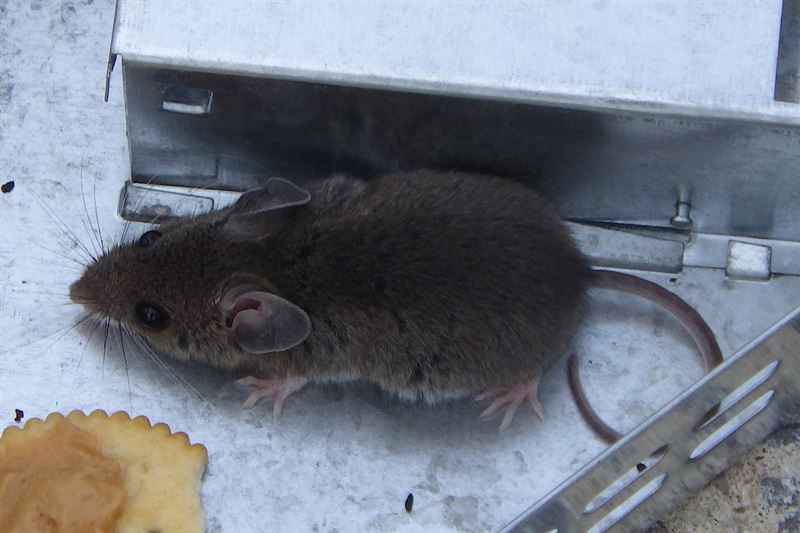
How Professional Mouse Control Actually Works
Mouse control works in four steps: an inspection that maps entry points and runways, saturation trapping to cut the population fast, sealing gaps down to 1/4 inch, and sanitation of contaminated areas.
Step 1: Inspection and Entry Point Mapping
The inspection looks for droppings, gnaw marks on corners and wiring, grease smudges on baseboards, nesting material in drawers and pantries, and entry points the size of a pencil diameter or larger. Common vulnerabilities include gaps around dryer vents, utility penetrations, garage door corners, and where siding meets the foundation. Mice will use the same routes repeatedly, so runways get mapped for trap placement.
Step 2: Rapid Population Reduction
Mouse populations grow fast, so initial trapping uses heavy saturation rather than a few traps scattered around. Professional snap traps placed perpendicular to runways, baited with protein-based attractants, catch more mice in the first 72 hours than hardware-store glue traps catch in weeks. Glue traps are avoided because they cause prolonged suffering, rarely kill quickly, and are not suitable around pets.
Step 3: Small-Gap Exclusion
Entry points down to 1/4 inch get sealed with copper wool, steel mesh, or properly applied caulk backed with metal. The exclusion work focuses heavily on exterior walls, garage thresholds, and utility penetrations where mice most commonly enter. Proper mouse exclusion is more detailed than rat exclusion because the openings are so much smaller.
Step 4: Sanitation of Contaminated Areas
Mouse urine and scent trails can signal safety to other mice. Nesting areas, food contact surfaces, and storage spaces get wiped down with an EPA-registered disinfectant instead of a dry sweep, clearing the scent trails that pull new mice back in. Contaminated insulation in attics and wall voids is replaced when the infestation has been active long enough to saturate it.