RodentExterminator.com Research · Updated November 2026
134 rodent statistics for 2026
About one American home in eight saw signs of mice or rats in the past year. Most of the numbers people repeat about rodents trace back to a press release or a pest company's blog. Every figure on this page links to the agency, study, filing or survey that produced it, with the date.
We run the US Rodent Index, which tracks rodent complaints in 12 cities. This page covers the rest of the picture: how many homes have rodents, which metros have it worst, what rodents carry, what poison does to kids and pets, and what the control trade looks like.
Rodent statistics at a glance
- 15.7 million of the 133.2 million occupied US homes saw signs of mice or rats inside in the 2023 survey, or 11.8% (U.S. Census Bureau, Sep 2024).
- 27% of Americans found a rodent in their home in the past year (NPMA, Oct 2023).
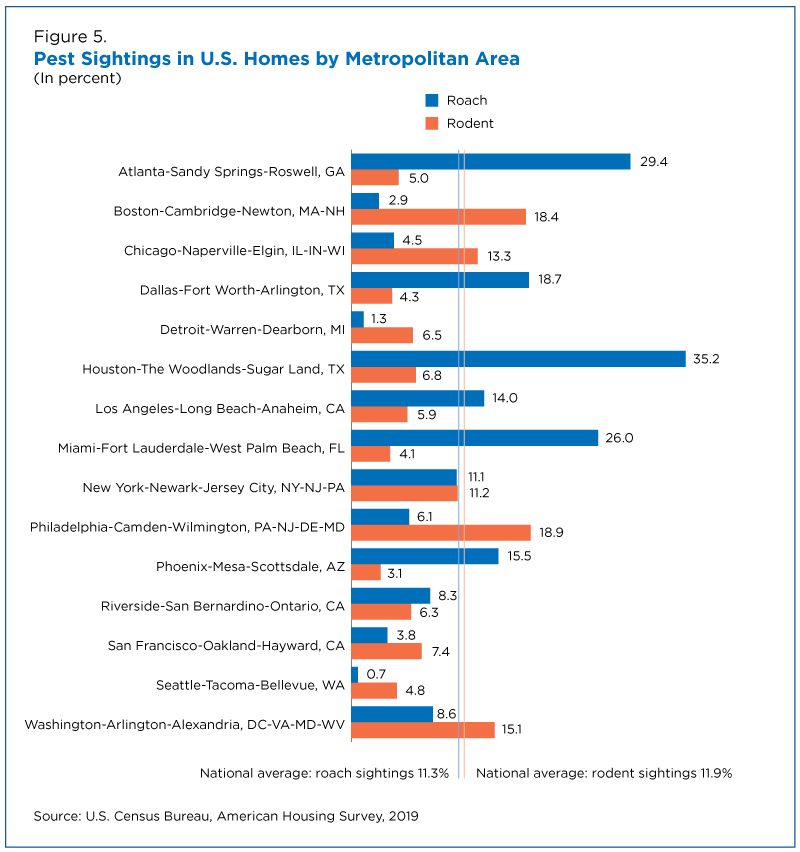
- Philadelphia has the highest rate of rodent sightings among the 15 largest metros, at 18.9% of homes (U.S. Census Bureau, Apr 2021).
- Rat numbers rose in 11 of 16 cities studied, or 69% (Science Advances, Jan 2025).
- New York City rat sightings reported to 311 fell 20.6% in a year, from 25,230 to 20,025 (NYC Department of Sanitation, Dec 2025).
- Twelve US cities logged 106,831 rodent complaints between them in 2025 (RodentExterminator.com US Rodent Index, Oct 2026).
- The US has recorded 890 hantavirus cases since 1993, and 35% of patients died (CDC, Apr 2026).
- New York City reported 24 leptospirosis cases in 2023, the most in any single year (NYC Health Department, Apr 2024).
- A mouse can fit through a hole the width of a pencil, 1/4 inch across (CDC, Apr 2024).
- One female house mouse can have 5 to 10 litters a year, with 5 or 6 pups in each (UC IPM, Jul 2025).
- US poison centers logged 8,452 single-substance rodenticide exposures in 2024, and 5,416 of them involved children age 5 or younger (America's Poison Centers, Dec 2025).
- Only 17% of Americans call a pest control professional at the first sign of rodents (NPMA, Oct 2024).
- Pest control workers held about 108,700 US jobs in 2025, with median pay of $45,250 a year (BLS, Sep 2026).
- The FDA takes action on peanut butter only when it averages one or more rodent hairs per 100 grams (FDA, Sep 2018).
How many US homes have rodents?
Rodents are a housing problem before they are a pest problem. The Census data shows it plainly: the homes with holes, leaks and leaning walls are the homes with mice.
How common are rodent sightings at home?
Between 11% and 12% of occupied US homes report signs of mice or rats in a given year. Surveys that ask people directly come back higher.
- In the 2021 survey, 15.3 million of 128.5 million occupied homes reported them (U.S. Census Bureau, Sep 2022).
- Nearly 14.8 million of about 124 million occupied homes reported rodents in the 2019 survey (U.S. Census Bureau, Apr 2021).
- That works out to a national average of 11.9% of households, a little above the 11.3% that saw roaches (U.S. Census Bureau, Apr 2021).
- About 2.9 million homes reported both roaches and rodents (U.S. Census Bureau, Apr 2021).
- About 9% of Americans say they had a rodent infestation at home in the past year, in a Harris Poll of 2,087 adults (NPMA, Oct 2023).
- 17% of Americans encountered rodents in their homes during 2025 (NPMA, Jan 2026).
- The trade association's long-running estimate is that rodents enter 21 million US homes each winter. It publishes no method for the figure (NPMA, Oct 2024).
- The Census Bureau also publishes modeled rodent-sighting estimates for every US county, built from the 2019 survey (U.S. Census Bureau, Jan 2024).
Which homes are most likely to have rodents?
Homes with structural damage, and owner-occupied homes slightly more than rentals.
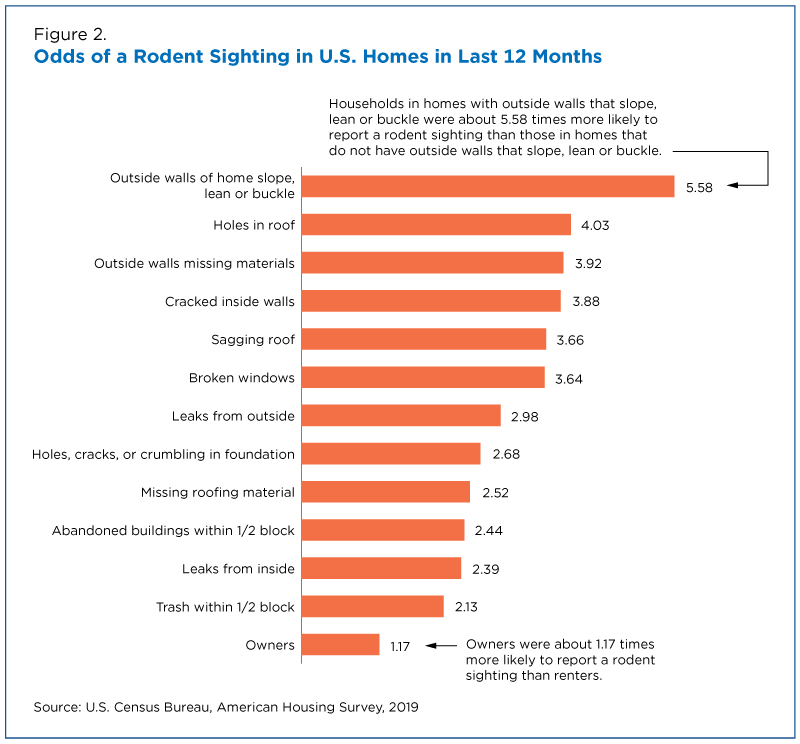
- Homes with outside walls that slope, lean or buckle were about 5.58 times more likely to report a rodent sighting (U.S. Census Bureau, Apr 2021).
- Holes in the roof raised the odds 4.03 times (U.S. Census Bureau, Apr 2021).
- Broken windows raised them 3.64 times (U.S. Census Bureau, Apr 2021).
- Holes, cracks or crumbling in the foundation raised them 2.68 times (U.S. Census Bureau, Apr 2021).
- Owners were about 1.17 times more likely than renters to report a rodent sighting (U.S. Census Bureau, Apr 2021).
- 7.2 million homes had open cracks or holes inside in 2021 (U.S. Census Bureau, Sep 2022).
- 5 million homes had a crumbling foundation or an open crack or hole in it (U.S. Census Bureau, Sep 2022).
Which metros have the most homes with rodents?
The Northeast has the mice and the Sun Belt has the roaches. Old housing stock and cold winters push rodents indoors, and the household numbers follow the map almost exactly.
Which metro areas report the most rodents?
After Philadelphia, the highest rates among the 15 largest metros are in Boston, Washington, Chicago and New York.
- Boston: 18.4% of homes, a rate the Census says is statistically tied with Philadelphia's (U.S. Census Bureau, Apr 2021).
- Washington, D.C.: 15.1% of homes (U.S. Census Bureau, Apr 2021).
- Chicago: 13.3% of homes (U.S. Census Bureau, Apr 2021).
- New York: 11.2% of homes, just under the national average (U.S. Census Bureau, Apr 2021).
Which metro areas report the fewest?
Phoenix, Miami and Dallas.
- Phoenix has the lowest rate of rodent sightings in the country's big metros, at 3.1% (U.S. Census Bureau, Apr 2021).
- Miami comes in at 4.1% (U.S. Census Bureau, Apr 2021).
- Dallas-Fort Worth comes in at 4.3%, against 18.7% for roaches (U.S. Census Bureau, Apr 2021).
Where do pest companies treat the most homes?
Los Angeles, by Orkin's count of new residential rodent treatments. Treatment data ranks cities differently than household surveys do, because it counts paid jobs.
- Los Angeles tops Orkin's 2026 list, with Chicago second and New York third (Orkin, Oct 2026).
- Albuquerque made the biggest jump, climbing 12 spots to No. 31 (Orkin, Oct 2026).
- California has four cities in the top 50, more than any other state (Orkin, Oct 2026).
- Los Angeles first took the top spot in 2025, ending a run of ten years at No. 1 for Chicago (Orkin, Oct 2025).
Is it rats or mice where you live?
Mice in the Midwest and Northeast, rats in the West, and a mix in the South.
- Nationally, 54% of pest companies say mice make up most of their rodent calls and 44% say rats (PCT, Dec 2025).
- Mice lead the calls for 92% of companies in the Midwest and 90% in the Northeast (PCT, Dec 2025).
- In the West, 77% of companies say rats lead (PCT, Dec 2025).
- By species, house mice lead for 47% of companies, roof rats for 26% and Norway rats for 16% (PCT, Dec 2025).
Are rat populations growing?
In most cities with good records, yes. New York is the recent exception, and it got there by taking the trash off the sidewalk.
What does the research show?
Rat complaints are rising in most cities studied, and the cities warming fastest are rising fastest.
- The study used between 7 and 17 years of sighting and inspection records per city, 12.2 years on average (Science Advances, Jan 2025).
- Washington, D.C. had the steepest climb, three times Boston's trend and 1.5 times New York's (Science Advances, Jan 2025).
- A city's long-run temperature increase accounted for 40.7% of the variation in rat trends (Science Advances, Jan 2025).
- Vegetation cover accounted for 34.3%. Greener cities saw slower growth (Science Advances, Jan 2025).
- Human population density accounted for 19.4% (Science Advances, Jan 2025).
- Three cities saw declines: Tokyo, Louisville and New Orleans (Science Advances, Jan 2025).
Is anything bringing the numbers down?
Sealed trash bins, in New York. Sightings fell every month after the city required them for small residential buildings.
- Rat sightings reported to 311 fell for 12 straight months, each compared with the same month a year earlier (NYC Department of Sanitation, Dec 2025).
- November 2025 had 931 sightings against 1,537 the November before, a 39.4% drop (NYC Department of Sanitation, Dec 2025).
- More than 70% of New York City's trash now has to go in containers (NYC Department of Sanitation, Dec 2025).
- Across the 12 cities we track, complaints fell from 122,880 in 2023 to 106,831 in 2025. Fewer complaints do not prove fewer rodents (RodentExterminator.com US Rodent Index, Oct 2026).
When do rodent complaints peak?
July, when rats are most active outdoors.
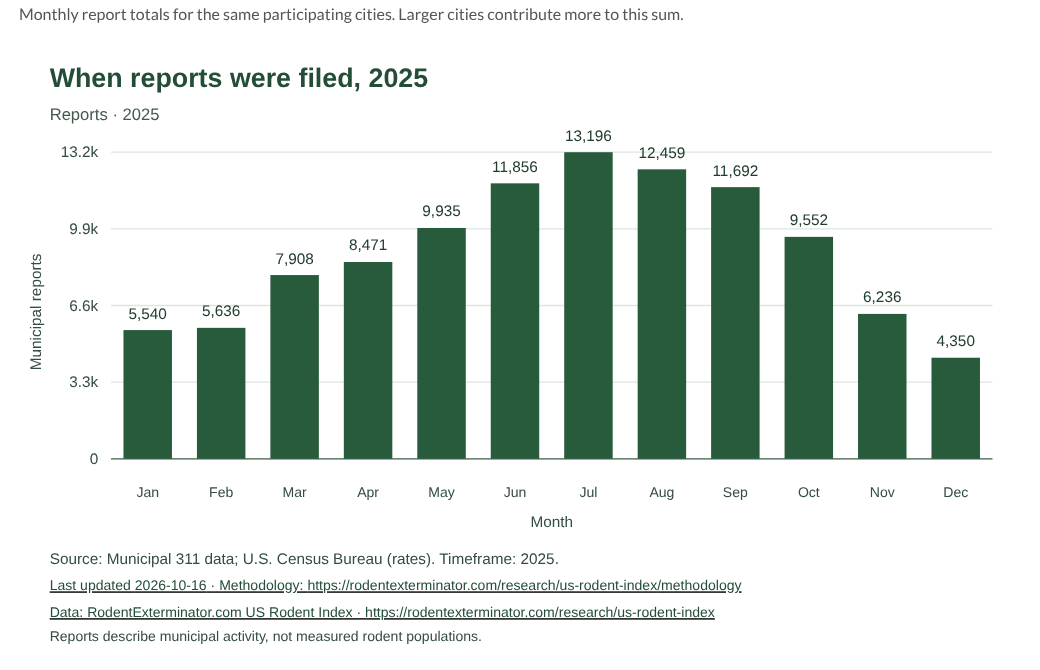
- The 12 index cities filed 13,196 complaints in July 2025 and 4,350 in December (RodentExterminator.com US Rodent Index, Oct 2026).
- Washington, D.C. filed the most per resident, 240.5 complaints for every 10,000 people (RodentExterminator.com US Rodent Index, Oct 2026).
How fast do rats and mice breed?
Fast enough that a missed pair in spring is a colony by fall.
- The average female Norway rat has 4 to 6 litters a year and can wean 20 or more young (UC IPM, Jun 2025).
- Roof rats average 3 to 5 litters, with up to 8 young in each (UC IPM, Jun 2025).
- House mice are born 18 to 21 days after conception and can breed at 5 to 6 weeks old (UC IPM, Jul 2025).
- A house mouse usually lives 9 to 12 months, though some have reached 3 years (UC IPM, Jul 2025).
What diseases do rodents spread?
The diseases are rare and the bad ones are very bad. Hantavirus kills about a third of the people who catch it.
How deadly is hantavirus?
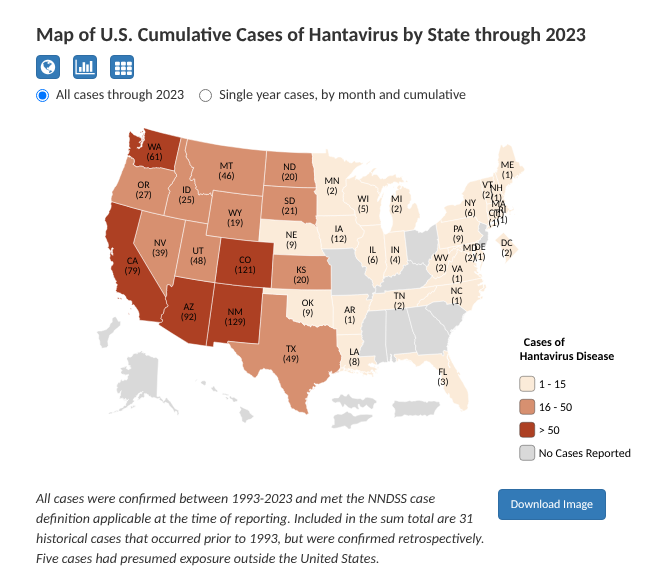
It is the deadliest rodent-borne disease in the US, and it is concentrated west of the Mississippi.
- 94% of US hantavirus cases occurred west of the Mississippi River (CDC, Apr 2026).
- New Mexico has the most cases on record with 129, followed by Colorado with 121 (CDC, Apr 2026).
- 62% of confirmed patients were male, and the median age was 38 (CDC, Apr 2026).
- 38% of people who develop respiratory symptoms from hantavirus pulmonary syndrome may die (CDC, May 2024).
- Symptoms usually start 1 to 8 weeks after contact with an infected rodent (CDC, May 2024).
- Pet rats can carry it too. A 2017 outbreak of Seoul virus reached 31 rat-breeding facilities in 11 states (CDC MMWR, Feb 2018).
- Of 163 people tested in that outbreak, 17 had recent infections, or 10.4% (CDC MMWR, Feb 2018).
What other diseases come from rats and mice?
Leptospirosis, plague, rat-bite fever and a virus carried by house mice. Leptospirosis is the one growing in cities.
- Leptospirosis causes about 1 million human cases and nearly 60,000 deaths worldwide each year (CDC, Feb 2026).
- New York City averaged 15 locally acquired cases a year from 2021 to 2023, up from 3 a year from 2001 to 2020 (NYC Health Department, Apr 2024).
- Of the city's 98 locally acquired cases since 2001, 94% were in men, and the Bronx reported the most with 37 (NYC Health Department, Apr 2024).
- Six of those patients died (NYC Health Department, Apr 2024).
- The US averages five human plague cases a year, with a range of 0 to 17 (CDC, Oct 2026).
- More than 80% of US plague cases have been the bubonic form (CDC, Oct 2026).
- Some studies find that 2% to 5% of people in urban areas have had a past infection with LCM, a virus spread by house mice (CDC, Jan 2025).
- Rat-bite fever symptoms usually begin 3 to 10 days after contact, and 3 in 4 patients develop a rash (CDC, Jul 2024).
What do city rats carry?
More than anyone had counted until researchers trapped and tested them in New York.
- The team collected 133 Norway rats from five sites in New York City (mBio, Oct 2014).
- 38% of the rats carried a strain of E. coli that causes gut illness in people (mBio, Oct 2014).
- 25% carried Bartonella, and 17% carried the bacterium behind rat-bite fever (mBio, Oct 2014).
- Eight rats tested positive for Seoul virus (mBio, Oct 2014).
What damage do rodents cause?
Nobody has a good national number for rodent damage, and the researchers who went looking say so themselves. What exists is a floor, and the floor keeps rising.
How much do rodents cost?
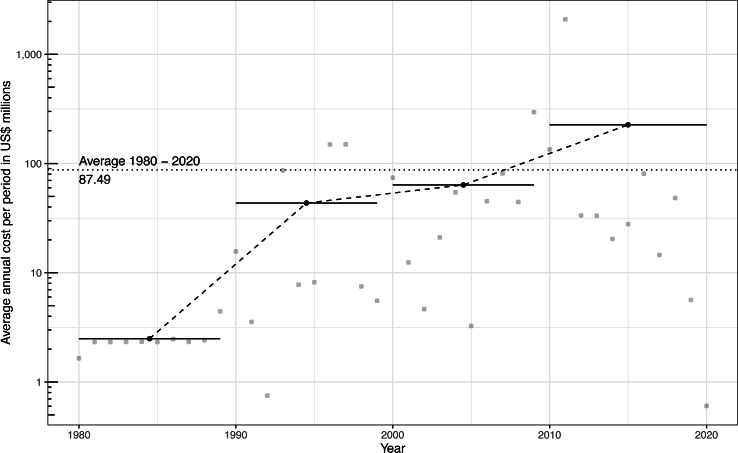
At least $3.6 billion in documented costs worldwide, which the study's own title calls the tip of the iceberg.
- Reported costs of invasive rodents reached $3.6 billion between 1930 and 2022 (PeerJ, Mar 2023).
- Since 1980 the reported average is $87.5 million a year (PeerJ, Mar 2023).
- 87% of the costs were damage, mostly to agriculture. The rest went to control (PeerJ, Mar 2023).
- North America accounted for 9% of reported costs, and the authors found only 99 documents worldwide that put a dollar figure on rodent damage (PeerJ, Mar 2023).
How much rodent contamination is allowed in food?
Some. The FDA sets a threshold for each food and acts only above it.
How do rodents get in, and how far do they roam?
Through gaps smaller than most people check for. Their range explains why a neighbor's problem becomes yours.
- A rat can squeeze under a door with a 1/2-inch gap (UC IPM, Jun 2025).
- Rats leave gnaw marks about 1/6 inch wide. Mouse marks are about 1/12 inch (UC IPM, Jun 2025).
- Norway rats forage 100 to 500 feet from their nests each night (UC IPM, Jun 2025).
- Roof rats routinely travel 300 feet or more for food (UC IPM, Jun 2025).
- House mice tend to stay within 30 feet of the nest, which is why poisoned mice often die inside the building (UC IPM, Jul 2025).
- A house mouse can jump 12 inches straight up from the floor (UC IPM, Jul 2025).
- An adult house mouse weighs about half an ounce (UC IPM, Jul 2025).
- The CDC advises keeping woodpiles 100 feet or more from the house and a foot off the ground (CDC, Apr 2024).
How risky is rodent poison?
Poison is the first thing most people reach for and the reason regulators keep tightening the rules. Most of the people it reaches are small children.
How many people are exposed to rat poison?
Thousands each year. Deaths are rare.
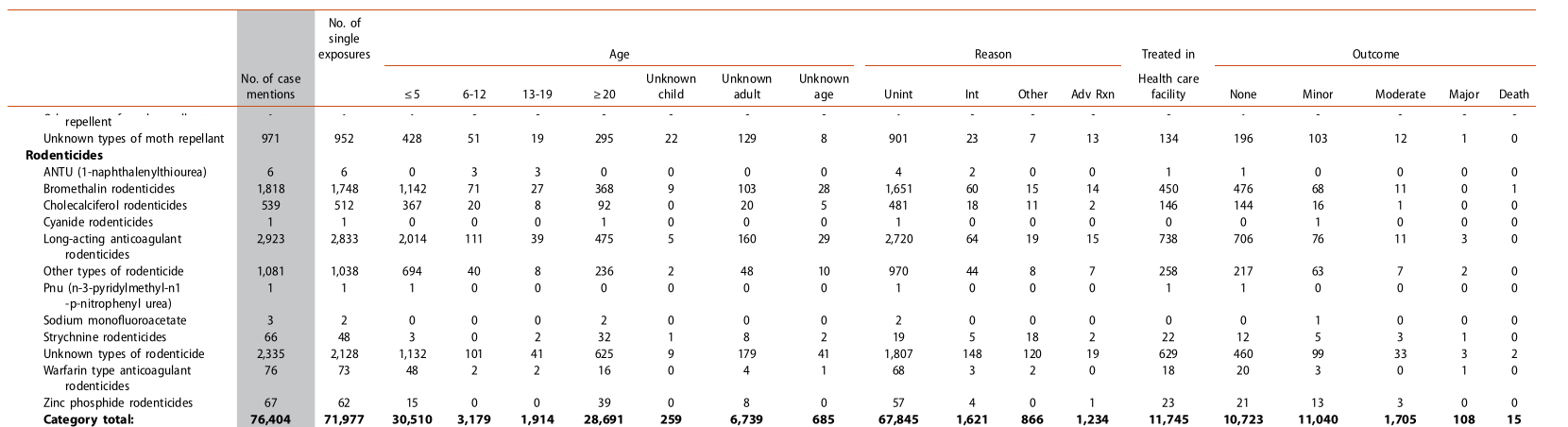
- Long-acting anticoagulants were the largest named category, with 2,833 single-substance exposures in 2024 (America's Poison Centers, Dec 2025).
- Bromethalin products came next with 1,748 (America's Poison Centers, Dec 2025).
- The rodenticide rows record three deaths for the year (America's Poison Centers, Dec 2025).
- A ten-year review found 2,674 bromethalin exposures with a known outcome, and 83.28% involved children (Clinical Toxicology, Mar 2019).
How often do pets get into rodent bait?
Often enough that rodenticide makes the ASPCA's top ten every year.
How are rodenticides regulated?
Tightly for consumers, and more rules are on the way for professionals.
- The EPA reached an agreement to cancel 12 d-CON products, 8 of which contained second-generation anticoagulants (EPA, May 2026).
- Production of those products stopped on December 31, 2014 (EPA, May 2026).
- Consumer baits now have to come in a ready-to-use bait station, and pellets are no longer allowed (EPA, Sep 2026).
- Second-generation anticoagulants for professional use must be sold in containers of at least 16 pounds, which keeps them off retail shelves (EPA, Sep 2026).
- Anticoagulant baits typically kill between four days and two weeks after a rodent starts feeding (EPA, Sep 2026).
- The EPA's 2008 decision covered 10 rodenticides, and its November 2022 proposals cover 11 (EPA, Nov 2026).
- The agency plans to extend protections to about 90 endangered and threatened species that rodenticides may affect (EPA, Nov 2026).
- 43% of pest companies have changed their rodent programs, or plan to, because of the coming EPA rules (PCT, Dec 2025).
How do homeowners and pros respond to rodents?
Most people wait. They set a few traps, the noise stops for a week, and the gap behind the dryer vent stays open.
What do homeowners do about rodents?
Less than the risk calls for. Fewer than half know rodents spread disease.
- 43% of Americans are aware that rodents can transmit dangerous diseases (NPMA, Oct 2024).
- For cleanup, the CDC's bleach mix is 1.5 cups per gallon of water, or 1 part bleach to 9 parts water (CDC, Apr 2024).
- Droppings and urine should soak in disinfectant for 5 minutes before you wipe them up (CDC, Apr 2024).
- A heavily infested home can need a dozen or more rat traps, set 10 to 20 feet apart (UC IPM, Jun 2025).
- Every opening larger than 1/4 inch needs sealing to keep rats out (UC IPM, Jun 2025).
If you are hearing scratching at night or finding droppings, our guide to the signs of a rodent infestation shows what to look for, and do I need an exterminator? helps you decide. To talk with a local rodent pro today, call (888) 733-3114.
What are pest professionals seeing?
More rodents, and more ways to track them without bait.
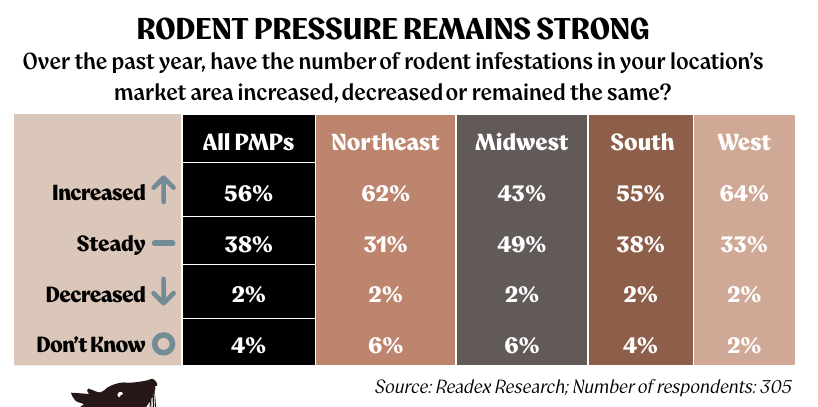
- 56% of pest companies say infestations in their market increased over the past year (PCT, Dec 2025).
- The West reported the most growth at 64%, and the Midwest the least at 43% (PCT, Dec 2025).
- 98% of companies use baits and 91% use traps (PCT, Dec 2025).
- Use of electronic rodent monitoring doubled in a year, from 12% of companies to 24% (PCT, Dec 2025).
- 25% of companies now sell rodent work only inside a recurring plan, up from 17% in 2024 (PCT, Dec 2025).
- Rentokil says its connected rodent monitoring system cuts rodenticide use by up to 60% (Rentokil Initial, Mar 2026).
How big is the rodent control business?
Rodent work used to be the job nobody wanted. It now brings in about a quarter of the average pest company's revenue, and the big operators have noticed.
How many people work in pest control, and what do they earn?
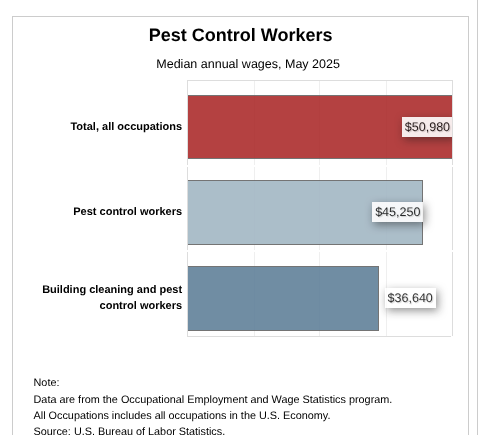
A little over 100,000 people, at pay below the national median.
- Employment of pest control workers should grow 6% from 2025 to 2035, faster than the average job (BLS, Sep 2026).
- The field should have about 13,700 openings a year over the decade (BLS, Sep 2026).
- 88% of pest control workers are employed by exterminating and pest control companies (BLS, Sep 2026).
- The lowest-paid 10% earned less than $34,680 and the highest-paid 10% earned more than $61,890 (BLS, Sep 2026).
- The median for all US occupations was $50,980 (BLS, Sep 2026).
How big are the largest pest control companies?
Rollins and Rentokil each bring in billions, and the US is where most of the money is.
- Rollins, the parent of Orkin, reported 2025 revenue of $3.8 billion, up 11.0% from 2024 (Rollins, Feb 2026).
- Its residential pest control revenue rose about 10% (Rollins, Feb 2026).
- About 75% of Rollins' business is recurring service and 15% is one-time jobs (Rollins, Feb 2026).
- Rollins had 21,946 employees at the end of 2025 (Rollins, Feb 2026).
- Rentokil, which owns Terminix, says about half of the world's pest control happens in the US and that the US market is growing about 6% a year (Rentokil Initial, Mar 2026).
- Rentokil kept 80.5% of its North American customers in 2025 (Rentokil Initial, Mar 2026).
- Rentokil employs about 63,400 people worldwide (Rentokil Initial, Mar 2026).
How much of that business is rodents?
About a quarter, and rising.
Glossary
- AHS
- American Housing Survey, run by the Census Bureau for HUD every two years.
- 311
- a city's non-emergency line, where residents report rat sightings.
- HPS
- hantavirus pulmonary syndrome, the lung disease caused by hantaviruses in the Americas.
- LCM
- lymphocytic choriomeningitis, a viral disease spread by house mice.
- NPDS
- National Poison Data System, the case database of US poison centers.
- SGAR
- second-generation anticoagulant rodenticide, the stronger class of rat poison now limited to professional use.
- PMP
- pest management professional.
- NPMA
- National Pest Management Association, the industry's trade group.
Methodology and sources
Each statistic links to the organization that produced it: a government agency, a peer-reviewed study, a company filing, or a survey from the group that ran it. We opened every link and found the number on the page before listing it. We left out figures we could not trace, including the common claim that rodents start a fixed share of house fires. Dates show when the source published or last updated the data. The poison center totals are our own sums of the rodenticide rows in Table 22A of the report. Household figures come from the 2019, 2021 and 2023 American Housing Surveys. The metro and housing-defect breakdowns use 2019, the latest year the Census Bureau has written up. We review this page every month and replace figures when a source updates.
- U.S. Census Bureau, Residents of 14 Million Housing Units Reported Seeing Roaches, 14.8 Million Saw Rodents in Last 12 Months
- U.S. Census Bureau, 2023 American Housing Survey, Housing Quality table
- U.S. Census Bureau, 2021 American Housing Survey housing quality infographic
- U.S. Census Bureau, County-level Model-based Estimates from 2019 American Housing Survey: Signs of Rodents
- RodentExterminator.com, US Rodent Index
- Science Advances, Increasing rat numbers in cities are linked to climate warming, urbanization, and human population
- NYC Department of Sanitation, press release 25-039
- CDC, Reported Cases of Hantavirus Disease
- CDC, About Hantavirus
- CDC MMWR, Outbreak of Seoul Virus Among Rats and Rat Owners, United States and Canada, 2017
- CDC, About Leptospirosis
- CDC, Plague maps and statistics
- CDC, About Lymphocytic Choriomeningitis
- CDC, About Rat-Bite Fever
- CDC, How to Seal Up to Prevent Rodent Infestations
- CDC, How to Clean Up After Rodents
- NYC Health Department, 2024 Health Advisory #10: Continued Increase in Leptospirosis Cases in New York City
- mBio, Detection of Zoonotic Pathogens and Characterization of Novel Viruses Carried by Commensal Rattus norvegicus in New York City
- PeerJ, Economic costs of invasive rodents worldwide: the tip of the iceberg
- FDA, Food Defect Levels Handbook
- UC IPM, Pest Notes: Rats
- UC IPM, Pest Notes: House Mouse
- America's Poison Centers, 2024 Annual Report of the National Poison Data System
- Clinical Toxicology, Medical outcomes of bromethalin rodenticide exposures reported to US poison centers
- ASPCA, The Top 10 Toxins of 2025
- EPA, Canceling Some d-CON Mouse and Rat Control Products
- EPA, Restrictions on Rodenticide Products
- EPA, Rodent Control Pesticide Safety Review
- NPMA, Rodent Awareness Week release, October 2023
- NPMA, Rodent Awareness Week release, October 2024
- NPMA, polar vortex release, January 2026
- Orkin, 2026 Rattiest Cities List
- Orkin, 2025 Rattiest Cities List
- PCT and Readex Research, 2025 State of the Rodent Control Market
- U.S. Bureau of Labor Statistics, Occupational Outlook Handbook: Pest Control Workers
- Rollins, Form 10-K for fiscal year 2025
- Rentokil Initial, Annual Report 2025