TX Rodent Control
Rodent Exterminator in Highland Park, TX
Updated
Highland Park has some of the oldest housing in the area. Census estimates show 43.0% of the town's housing units were built before 1960, while 23.5% date from 2000 or later. An old house and a recent rebuild often share a fence. Older construction has more places for a rat to get in, and demolition next door can send rodents looking for a new home, so both kinds of house are covered here.
Source: U.S. Census Bureau, American Community Survey 5-Year Estimates, 2019-2023, table B25034
No obligation · Same-day service in many areas
Sealing a Pre-1960 Highland Park House
Exclusion on an older house takes patience. Wood trim shrinks, mortar falls out and additions built in different decades meet at uneven seams. The newer 23.5% of Highland Park units, built in 2000 or later, have fewer of those problems but still have vents and line openings to check. On any house, close gaps with materials rats cannot chew: sheet metal, hardware cloth and mortar. Ask for original details such as wood vents to be screened from behind so the look stays the same. The rodent exclusion guide describes a full job.
Source: U.S. Census Bureau, American Community Survey 5-Year Estimates, 2019-2023, table B25034
What to check
- Look where an addition joins the original house for open seams.
- Check the chimney top for a cap and intact screen.
- Inspect wood trim at the roofline for gnawed or rotted spots.
Crawl Spaces, Seams and Vines on Older Homes
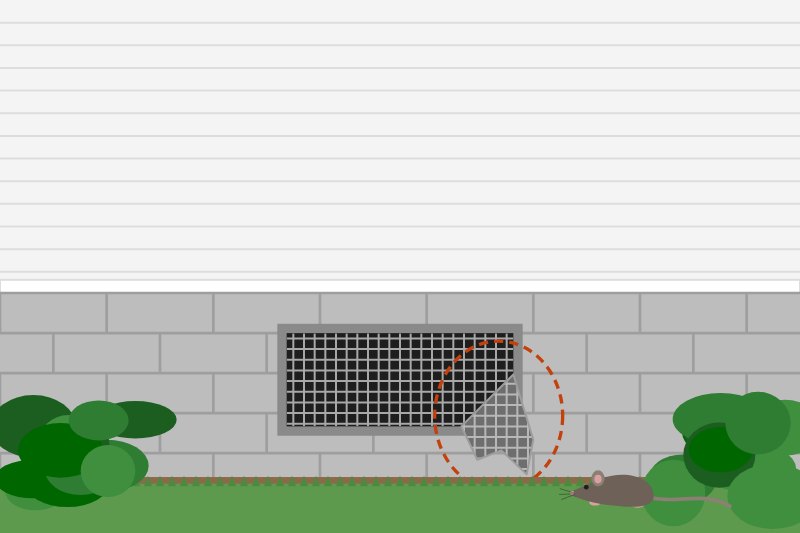
Crawl Space Vents and Hatches
Pier-and-beam houses breathe through vents near the ground, and the screens on them corrode. A missing screen or a loose access door lets rats under the whole house. Fit heavy mesh and a tight hatch.
Seams Between Additions
Where a sunroom or garage was added later, the old and new walls rarely meet perfectly. Look along the joint from foundation to roof for gaps hidden by trim or downspouts.
Ivy and Vine-Covered Walls
Vines hide holes and give rats a way to climb to upper windows and eaves. Cut vines back from the roof edge and inspect the wall they covered.
Chimneys and Roof Vents
An uncapped chimney or a plumbing vent with a broken collar opens directly into the house. View them from the ground with binoculars and ask for metal caps where one is missing.
Old Houses and Recent Rebuilds Side by Side
Year built, share of housing units
43.0%
Built before 1960
±5.5 points
10.5%
Built 1960 to 1979
±4.4 points
23.0%
Built 1980 to 1999
±3.9 points
23.5%
Built 2000 or later
±5.7 points
Source: U.S. Census Bureau, American Community Survey 5-Year Estimates, 2019-2023, table B25034
Building type, share of housing units
81.3%
Single-family detached
±8.9 points
12.3%
Buildings of 5+ units
±2.7 points
Source: U.S. Census Bureau, American Community Survey 5-Year Estimates, 2019-2023, table B25024
Every housing share for Highland Park prints on the cards above. By age, 43.0% of units were built before 1960, 10.5% from 1960 to 1979, 23.0% from 1980 to 1999 and 23.5% in 2000 or later. Detached houses are 81.3% of units, and 12.3% of units are in buildings of five or more.
Source: U.S. Census Bureau, American Community Survey 5-Year Estimates, 2019-2023, table B25034; U.S. Census Bureau, American Community Survey 5-Year Estimates, 2019-2023, table B25024
Identifying Rodents Around Highland Park Homes
Roof Rat
Mature trees and ivy suit the roof rat, a lean rat with a sharp snout and a long, thin tail. It nests high, in attics, in dense vines and in palm or oak canopies. Fruit with hollowed-out sides, droppings on top of fence rails and noise in the attic around midnight are its usual signs.
Norway Rat
The Norway rat is bigger and lives low. It has a heavy body, a blunt face and short ears. It burrows under slabs, along alley fences and beneath garbage storage. Check for holes with smooth, worn edges and for capsule-shaped droppings near trash carts and compost.
House Mouse
A house mouse is light brown to grey with a slim tail and round ears. In an old house it uses gaps around radiator pipes, floor registers and basement windows. You will see fine black droppings in the pantry or hear faint gnawing in a wall late in the evening.
Highland Park Bars Brush, Downed Timber and Rubbish on Lots
The Town of Highland Park's Code Compliance page says it is unlawful to let weeds, brush or any unsightly matter grow on a lot, and that dead vegetation, downed timber, trash and rubbish may not pile up or remain. It also asks that rear easements be kept clear. The page says nothing about rodents. Those same rules remove what a rat needs: cover and nesting material. Clear fallen limbs after storms, thin ivy on fences and keep the easement behind your lot open. The rat control guide covers trapping.
What to check
- Walk the rear easement and look for burrows along the fence line.
- Part the ivy on walls and fences and check for nests or droppings.
- Look under fruit trees for gnawed fruit on the ground.
Mice in Older Highland Park Walls and Basements
With 43.0% of Highland Park units built before 1960, many houses have crawl spaces, basements and plaster walls with open cavities behind them. A mouse that gets under the house can travel inside the walls to any floor. Start below: look at crawl space vents, the access hatch and the gaps where old pipes come up through the floor. Indoors, set snap traps in the kitchen and near the furnace closet, and keep pantry food in jars or tins. The mouse control guide has more on placement.
Source: U.S. Census Bureau, American Community Survey 5-Year Estimates, 2019-2023, table B25034
What to check
- Check each crawl space vent for a torn or missing screen.
- Look around radiator and steam pipes where they pass through floors.
- Open the cabinet beside the refrigerator and look for droppings.
Love Field Station Months for Highland Park
Average low at or below 40F
January and December
Highest average highs
July and August
Source: NOAA National Centers for Environmental Information (NCEI), 1991-2020
Station: Dallas Love Field Airport weather station
For Highland Park the closest station is the Dallas Love Field Airport weather station, and its NOAA normals give an average low of 40F or lower in only January and December. Its warmest average highs fall in July and August. Crawl spaces and attics in older houses deserve a look before the January cold arrives. Training from Texas A&M AgriLife Extension describes Norway rat reproduction as peaking in both spring and fall, when alley fences and rear easements are worth checking for new holes.
Source: NOAA National Centers for Environmental Information (NCEI), 1991-2020; Texas A&M AgriLife Extension Service, accessed 2026
Why Older Highland Park Homes Take Longer
Crawl Space or Slab
A house on piers has an entire underside to inspect, screen and sometimes clean. A slab house has less to cover below but may need more work at the roof.
Historic Materials
Matching old wood vents, slate or clay tile and brick takes more care than standard repairs. Say up front which details you want preserved so the repair plan accounts for them.
Size of the Roof and Attic
Large houses with several roof levels, dormers and finished attic rooms have more edges where rats can enter and more space to check for nests.
Highland Park Homes and Neighboring Cities
This guide is for homes inside the Town of Highland Park, which appears on Dallas County's list of cities. The City of Dallas surrounds much of the town and has its own guide on this site, as do Richardson, Irving and Garland. Code rules here are the town's own, so a house across the line in Dallas follows different ones. Check your tax statement if you are unsure which side your address is on.
Also Serving
The Texas service area guide lists Highland Park under Dallas County, along with Irving and 8 other cities.
Highland Park Questions on Alleys, Remodels and Old Homes
Demolition removes shelter, and rodents living there look for the nearest replacement. Before work starts, close gaps at your crawl space vents, garage and fence line, and remove ivy or stored items along the shared side. Set a few traps in the garage and attic so you learn quickly if anything has moved in.
They have more ways in at ground level. The open space under a pier-and-beam floor is dry and sheltered, and every pipe that comes up through the floor is a possible route inside. Sound vent screens, a tight access door and sealed pipe openings make an older raised house as tight as a newer one.
You can keep some of it if you manage it. Trim it well below the eaves and away from windows and vents, and thin it enough that you can see the wall. Check behind it each season for holes and droppings. Thick, untrimmed ivy that reaches the roof is hard to defend.
The town's code compliance page asks that rear easements stay clear, and the adjoining owner normally maintains the part behind the lot. Keep brush cut, pick up fallen limbs and store carts where the town directs. A tidy easement also lets you spot burrows along the back fence before they spread.
An empty building is quiet and undisturbed, which rodents like. Remove food, close the damper or cap the chimney, and seal door gaps before you lock it up. Walk through it regularly and look for droppings on counters and floors. Leave a few traps set and check them on each visit.
Attic Rat and Exclusion Guides for Older Homes
Free Highland Park Rodent Inspection
Scratching in an old plaster wall or burrows along the alley fence? A Highland Park resident who calls reaches a trusted local pest pro, with no obligation to book.
(888) 733-3114No Obligation · Same-Day Service in Many Areas
- A local rodent control company picks up.
- They ask what you have seen and where.
- No obligation. Ask about an inspection and pick a time.
Or find a local rodent exterminator by phone.
Highland Park Sources
- U.S. Census Bureau, American Community Survey 5-Year Estimates, 2019-2023, table B25034
- U.S. Census Bureau, American Community Survey 5-Year Estimates, 2019-2023, table B25024
- NOAA National Centers for Environmental Information (NCEI), 1991-2020
- Town of Highland Park, Texas, accessed 2026
- Texas A&M AgriLife Extension Service, accessed 2026
- Dallas County, Texas, accessed 2026