TX Rodent Control
Rodent Exterminator in Garland, TX
Updated
Garland's own ordinance counts harborage for rodents as a nuisance in Section 32.50, so conditions that shelter rodents can be a code matter as well as a pest one. The city's housing has a clear center of gravity, too: 43.1% of units were built from 1960 to 1979, according to Census estimates, and homes from that era have had many years for vent screens to rust, door frames to shift and old pipe openings to loosen. This page walks through signs, likely entry points and what to ask.
Source: U.S. Census Bureau, American Community Survey 5-Year Estimates, 2019-2023, table B25034; City of Garland, TX, Code of Ordinances (via eCode360), accessed 2026
No obligation · Same-day service in many areas
Decades of Wear on Garland Homes Built 1960 to 1979
With 43.1% of Garland housing units built from 1960 to 1979 and another 11.4% before 1960, many homes carry decades of small repairs and wear. Typical trouble spots in homes of that age include rusted vent screens, gaps where the foundation meets the siding, and old pipe or cable holes patched with material rodents chew through. Good rodent exclusion replaces weak patches with metal mesh, sheet metal or mortar and seals each gap in order. Ask to see photos of each repair.
Source: U.S. Census Bureau, American Community Survey 5-Year Estimates, 2019-2023, table B25034
What to check
- Check foundation vents and gable vents for rusted or torn screens.
- Look where the siding meets the foundation for gaps or chewed edges.
- Look for old patches around pipes made from foam or wood filler.
Rusted Screens and Old Patches on Garland Homes
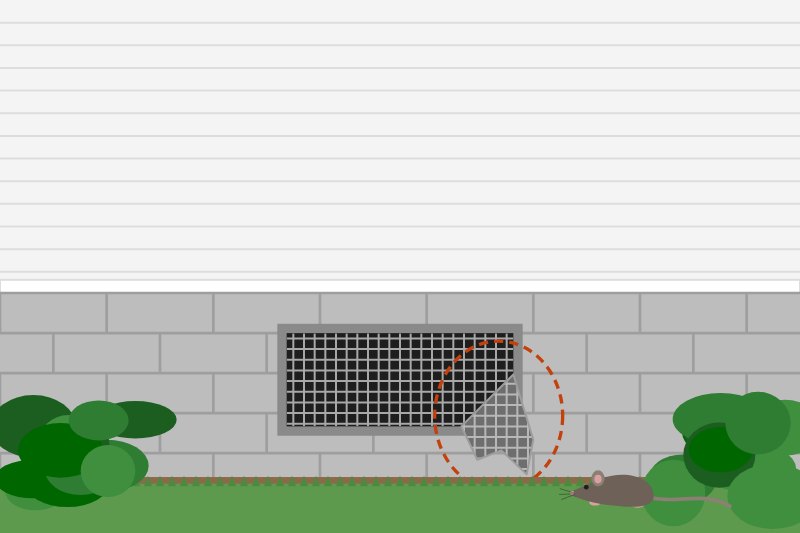
Rusted Vent Screens
Metal vent screens corrode over time, and even a small tear lets rodents in. Check every foundation and gable vent, and replace damaged screens with heavy wire mesh.
Siding and Foundation Gaps
Settling can open a gap between the bottom of the siding and the foundation. Look along that line all the way around the house for gaps, chewed edges and droppings.
Patched Pipe Holes
Older homes may have pipe and cable holes filled with foam, putty or wood filler. Rodents can chew through those materials. Look for gnaw marks and loose patches outside and under sinks.
Worn Door Sweeps
A door sweep that has flattened or torn leaves a gap at the threshold. Close each exterior door and look for daylight from inside.
Most Garland Homes Date to the Middle Decades
Year built, share of housing units
11.4%
Built before 1960
±0.9 points
43.1%
Built 1960 to 1979
±1.7 points
28.8%
Built 1980 to 1999
±1.6 points
16.8%
Built 2000 or later
±1.2 points
Source: U.S. Census Bureau, American Community Survey 5-Year Estimates, 2019-2023, table B25034
Building type, share of housing units
69.4%
Single-family detached
±1.4 points
23.1%
Buildings of 5+ units
±1.6 points
Source: U.S. Census Bureau, American Community Survey 5-Year Estimates, 2019-2023, table B25024
The housing cards put most Garland homes in the middle decades: 43.1% from 1960 to 1979 and 28.8% from 1980 to 1999, with 16.8% built in 2000 or later. On type, 69.4% of units are single-family detached and 23.1% sit in buildings of five or more units. For older detached houses, a full exterior walk-around is the best first step, since the owner controls every opening.
Source: U.S. Census Bureau, American Community Survey 5-Year Estimates, 2019-2023, table B25034; U.S. Census Bureau, American Community Survey 5-Year Estimates, 2019-2023, table B25024
Telling Roof Rats, Norway Rats and Mice Apart
Roof Rat
Think trees and attics when you think of roof rats. Look for a slim animal with a pointed snout, big ears and a long, thin tail, often seen running along a fence rail or power line at night. Their droppings have pointed tips and turn up in attics, on top of water heaters and along high shelves.
Norway Rat
Norway rats are the burrowers. They are bulkier, with a blunt snout, small ears and a tail shorter than the body. Signs sit near the ground: holes along the foundation or under a shed, smooth runways worn through grass, and large droppings with blunt ends by the garage wall or trash area.
House Mouse
A house mouse is palm-sized or smaller, with a slender tail and large ears. Mice often reveal themselves in the kitchen first, through droppings like tiny dark specks on counters and shelves, nibbled crackers or cereal, and a faint stale odor. Squeaking or rustling inside a lower cabinet at night is another clue.
Garland Code Counts Rodent Harborage as a Nuisance
Garland's Code of Ordinances, in Chapter 32, defines a nuisance to expressly include harborage for rodents, alongside stagnant water, filth, weeds and rubbish. Section 32.53 then makes it an offense to cause, suffer or allow a nuisance on a property. For a household, the practical reading is simple: piles of rubbish, weeds and standing water are the conditions rats use, and clearing them is prevention. If rats are already active, see rat control for trapping, removal and sealing.
Source: City of Garland, TX, Code of Ordinances (via eCode360), accessed 2026
What to check
- Empty anything holding standing water, such as buckets, tarps and clogged gutters.
- Clear rubbish and weeds from along the fence and behind the garage.
- Look for smooth runways worn through grass between cover and the house.
Mice Enter Garland Houses Low, Under Doors and Seals
Garland is a city of houses, with 69.4% of housing units being single-family detached. In a house, mice usually enter low: under a worn door sweep, through a gap in the garage door seal or around a pipe. From there they head for food and warmth in the kitchen and utility room. Keep food in hard containers, clean up crumbs and pet food at night, and place traps along the walls where droppings show up. Mouse control explains trapping choices and when sealing should follow.
Source: U.S. Census Bureau, American Community Survey 5-Year Estimates, 2019-2023, table B25024
What to check
- Look inside lower kitchen cabinets for droppings and nibbled packages.
- Check the door sweep on each exterior door for wear.
- Pick up pet food and water bowls at night.
Spring and Fall Rat Breeding and Cold Months in Garland
Average low at or below 40F
January, February and December
Highest average highs
July and August
Source: NOAA National Centers for Environmental Information (NCEI), 1991-2020
Station: Richardson, TX co-op weather station
The month cards for Garland draw on the Richardson, TX co-op weather station, whose NOAA normals show average lows at or below 40F in January, February and December and its highest average highs in July and August. When nights turn cold, walk around the house and look for fresh openings. According to Texas A&M AgriLife Extension, Norway rat reproduction peaks in spring and fall, which is a good reason to check a Garland yard for burrows at those times of year.
Source: NOAA National Centers for Environmental Information (NCEI), 1991-2020; Texas A&M AgriLife Extension Service, accessed 2026
Worn Screens and Seals Add Up in Older Garland Homes
Replacing Worn Materials
An older home may need new vent screens, door sweeps and pipe seals in several places at once. The more parts that need replacing, the larger the sealing portion of the plan.
Yard Cleanup Before Treatment
Rubbish piles, weeds and standing water may need clearing before trapping works well. Doing that yourself can reduce the scope, so ask how it changes the plan.
Attic and Crawl Space Access
Tight attics and hard-to-reach spaces take longer to inspect and repair. Ask whether the price covers all of these areas or only the parts with visible activity.
Garland Writes Its Own Nuisance and Property Rules
This page covers Garland, one of the cities named on Dallas County's list. Dallas, Richardson, Mesquite and Plano each have their own pages on this site. Each city writes its own nuisance and property rules, so confirm which city your address is in, especially near a line, before relying on any rule mentioned here.
The Texas service area guide lists Garland under Dallas County, along with Grand Prairie and 8 other cities.
Garland FAQs on Standing Water and Neighbor Rubbish
It can. Rats need water as well as food and shelter, and buckets, tarps, clogged gutters and leaking hoses can supply it. Empty and store containers, clear gutters, and fix leaks. Taking away water, food and cover together gives rats the least reason to stay.
Vent screens, door sweeps and old patches around pipes are worth checking first. Settling can also open gaps along the bottom of the siding. Walk around the house, look at every vent and door, and note any gap or chewed edge.
A friendly word with the neighbor is often the quickest route. Failing that, ask the city how to report it. Meanwhile, keep your own side clear, store items off the ground and away from the fence, and watch for burrows or runways along the fence line.
Size and shape tell most of the story. Mouse droppings are tiny, like dark specks or small grains. Rat droppings are much larger, either pointed at the ends or blunt. A photo next to a coin helps. See the droppings guide on this site for pictures and comparisons.
Trapping removes the mice already inside and can give relief quickly, but more will follow unless the openings are found. If you cannot find them, an inspection that checks the foundation line, vents, doors and utility entries can locate the gaps.
Attic Rats and Droppings ID for Garland Homeowners
Free Garland Rodent Inspection
Rats by the garage or mice in the kitchen cabinets? Call from Garland and you are linked with a trusted local pest pro. Calling about your Garland home commits you to nothing.
(888) 733-3114No Obligation · Same-Day Service in Many Areas
- A local rodent control company picks up.
- They ask what you have seen and where.
- No obligation. Ask about an inspection and pick a time.
Or find a local rodent exterminator by phone.
Garland Sources
- U.S. Census Bureau, American Community Survey 5-Year Estimates, 2019-2023, table B25034
- U.S. Census Bureau, American Community Survey 5-Year Estimates, 2019-2023, table B25024
- NOAA National Centers for Environmental Information (NCEI), 1991-2020
- City of Garland, TX, Code of Ordinances (via eCode360), accessed 2026
- Texas A&M AgriLife Extension Service, accessed 2026
- Dallas County, Texas, accessed 2026