Visual guide
How High Can Mice Jump? A Visual Size Guide
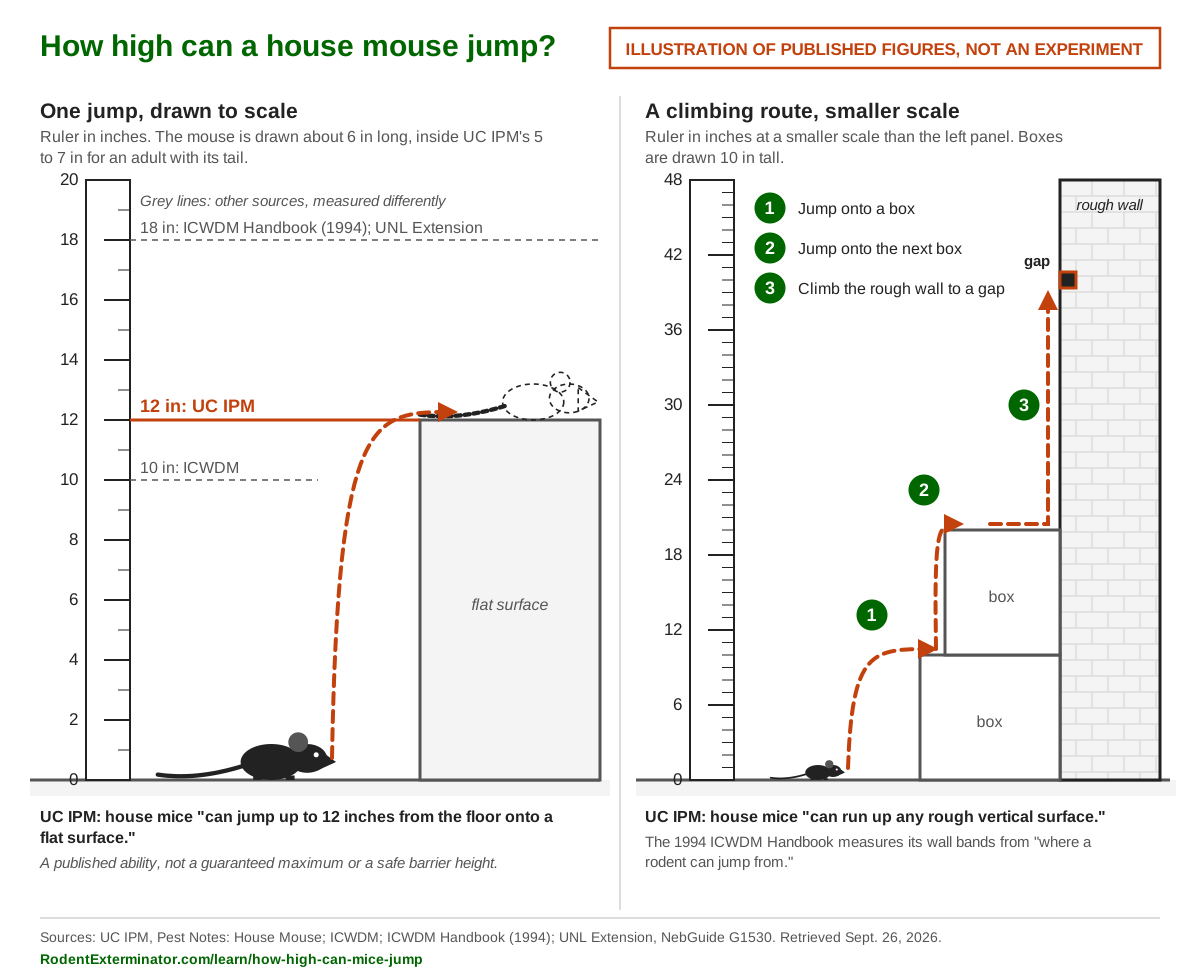
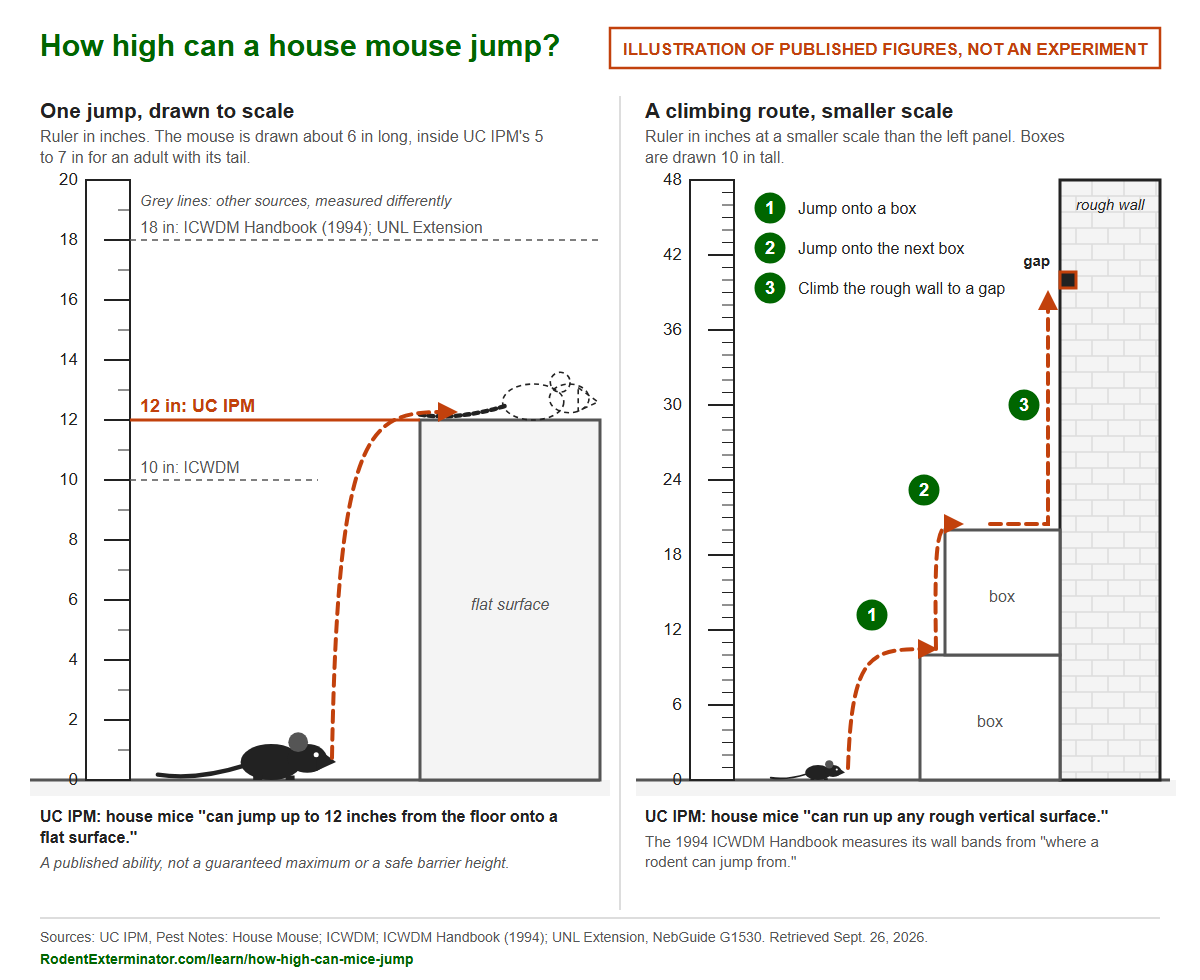
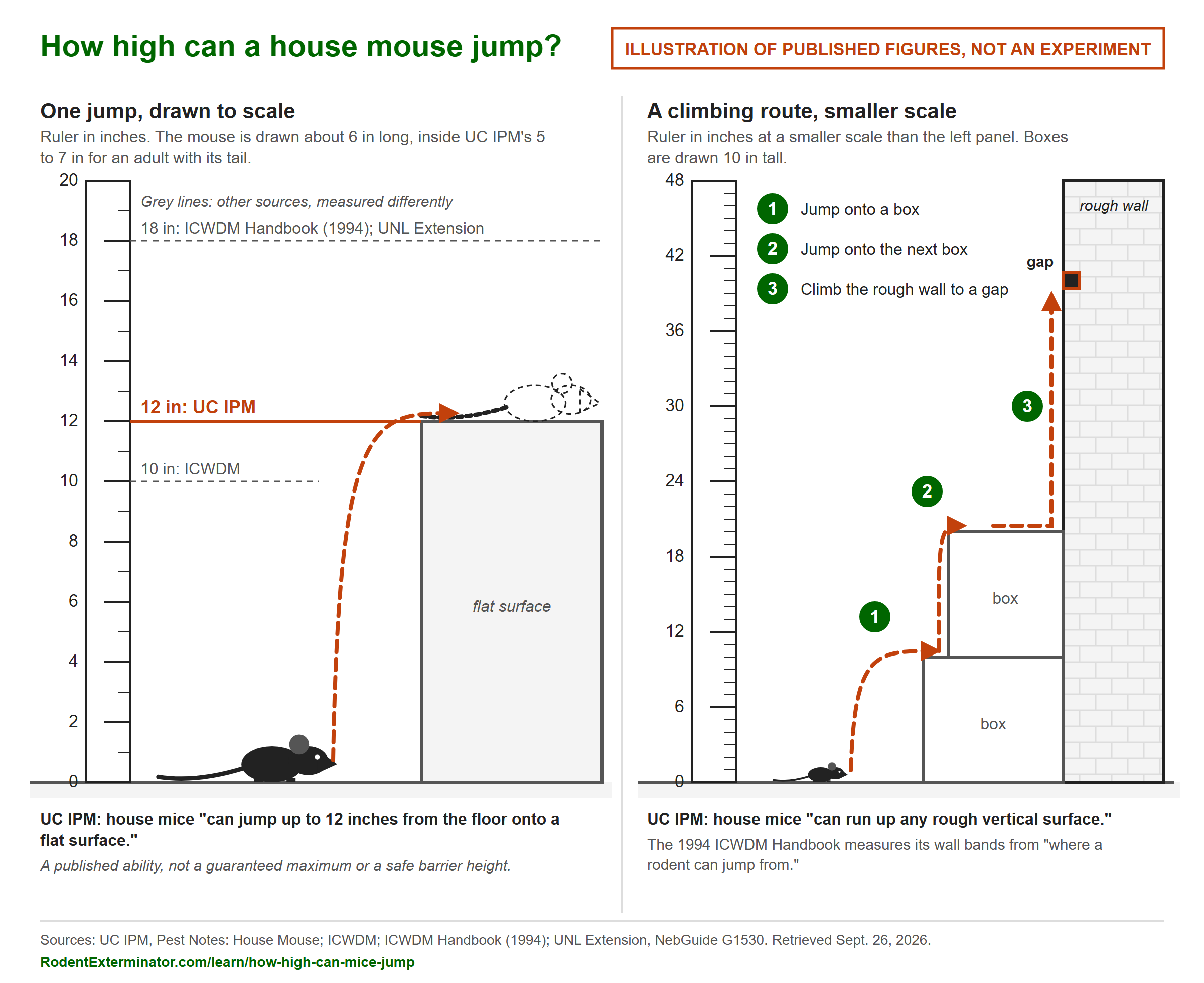
UC IPM says house mice "can jump up to 12 inches from the floor onto a flat surface." Read that as a published ability. It is not a guaranteed maximum, and it is not a safe height for a barrier. Other sources say 10 or 18 inches, and the table below shows each one.
Published Jump Heights, Side by Side
Published sources do not agree on one number. Every figure below is for house mice, not rats.
| Height | The source's words | Measured | Covers | Source |
|---|---|---|---|---|
| 12 inches | can jump up to 12 inches from the floor onto a flat surface | From the floor onto a flat surface | House mice. Updated July 2025. | UC IPM |
| 10 inches | House mice can jump up to 10 inches from a flat surface. | From a flat surface; no landing is named | House mice. | ICWDM |
| 18 inches | jump as high as 18 inches (46 cm) from a floor onto an elevated surface | From a floor onto an elevated surface | House mice. Listed apart from rats. Published 1994. | ICWDM Handbook |
| 18 inches | jump up 18 inches vertically | Straight up; no surface is named | House mice. Listed apart from rats. Revised 2009. | UNL Extension |
This page does not average these numbers or pick one as the true height. Whichever figure you read, it tells you what a mouse can do. It does not tell you a height that keeps mice out.
One Jump Versus a Climbing Route
A jump figure describes one leap. A mouse does not have to reach a high spot in one leap.
UC IPM also says house mice can run up any rough vertical surface. On a rough wall, the height of one jump is not the limit.
Boxes, bins or a woodpile by a wall can work like stairs. Each one gives the mouse a new place to start from. A 1994 handbook sets its sheet metal wall bands 30 inches above "where a rodent can jump from." That advice is for farm, dock and utility sites such as barns, corn cribs and pumping plants. The handbook adds that guards must be placed so rodents can't reach their edges by climbing or jumping.
Our guide Can Mice Climb Walls? draws the other routes on a whole house, such as cables, plants and rough brick.
What This Means for Sealing Gaps and Storage
None of these numbers is a safe height. Use them to see risk, then seal and store as if a mouse can reach any shelf.
- UC IPM says mice can get in through openings as small as 1/4 inch. Check high and low for gaps that size. Our guide to rodent entry points in a house works from the roofline down.
- Seal small cracks and openings with wire screen or coarse steel wool. The rodent exclusion page goes deeper on sealing materials.
- Keep all food storage and garbage containers sealed. House mice can chew on containers meant to protect food from rodents. Check your containers for chew marks now and then. Store bulk and pet foods in metal containers with tight-fitting lids.
- Mice can live inside a pallet of feed for long periods without going to the floor. A high shelf is not the same as a sealed container.
- Keep boxes, bins and firewood away from walls, vents and shelves, so they do not act as steps.
Download the Graphic
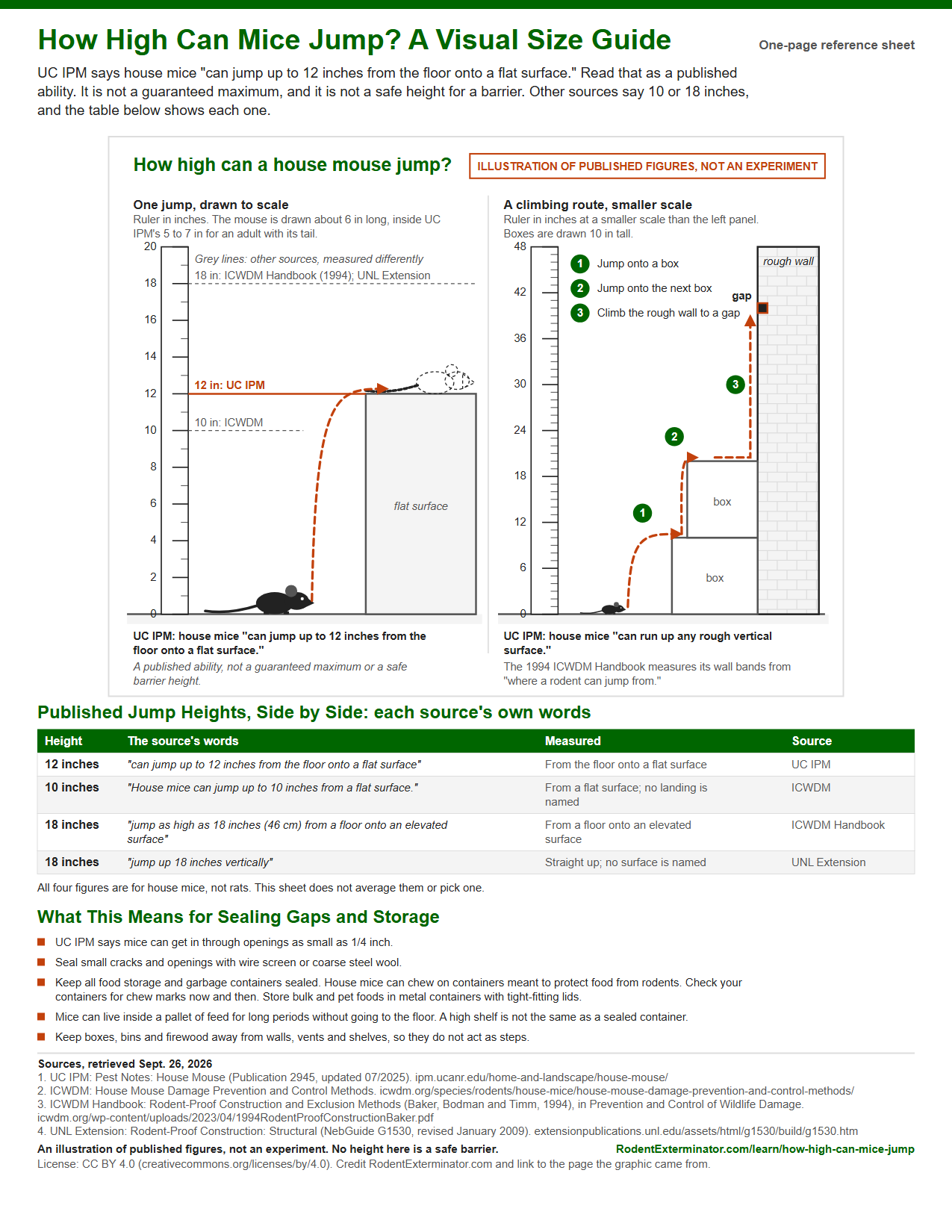
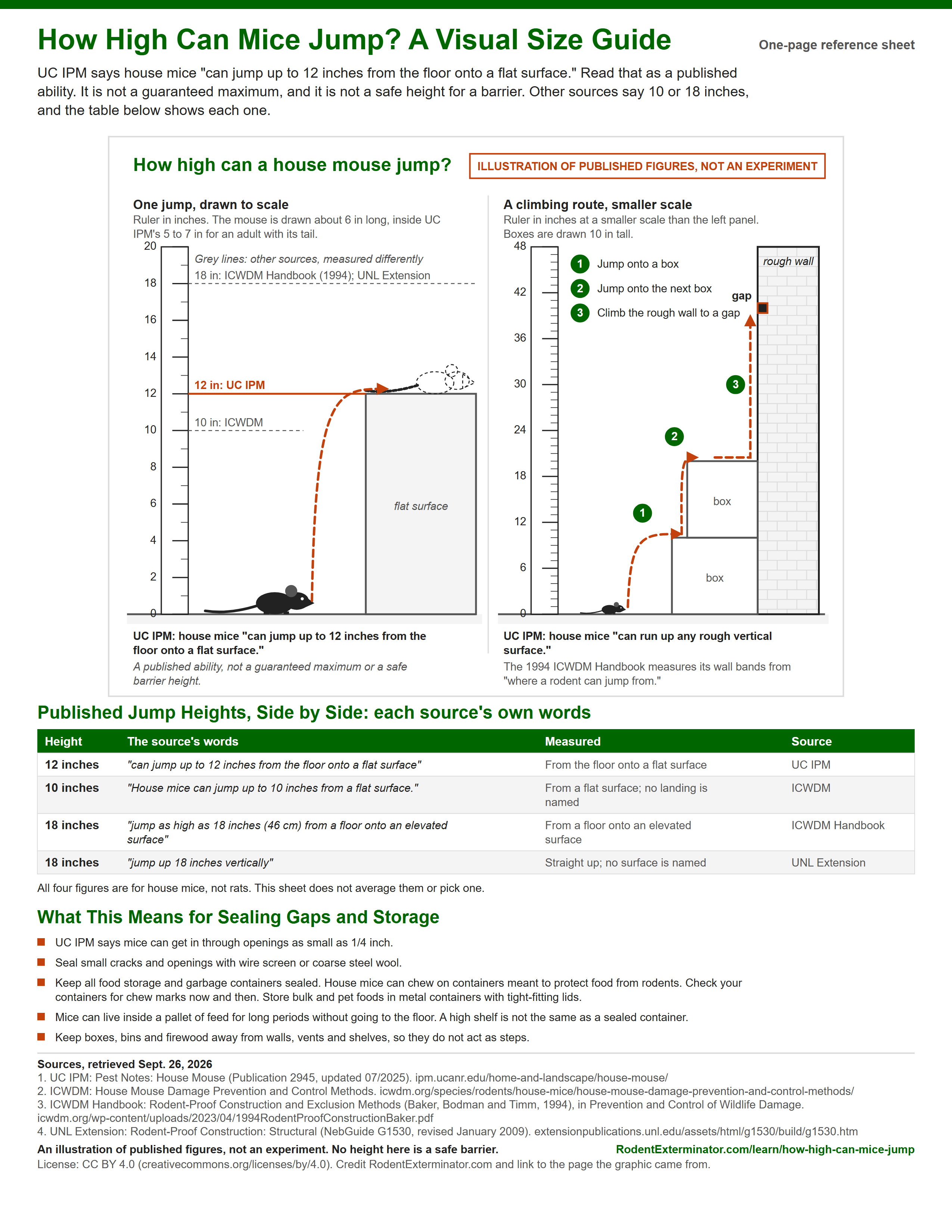
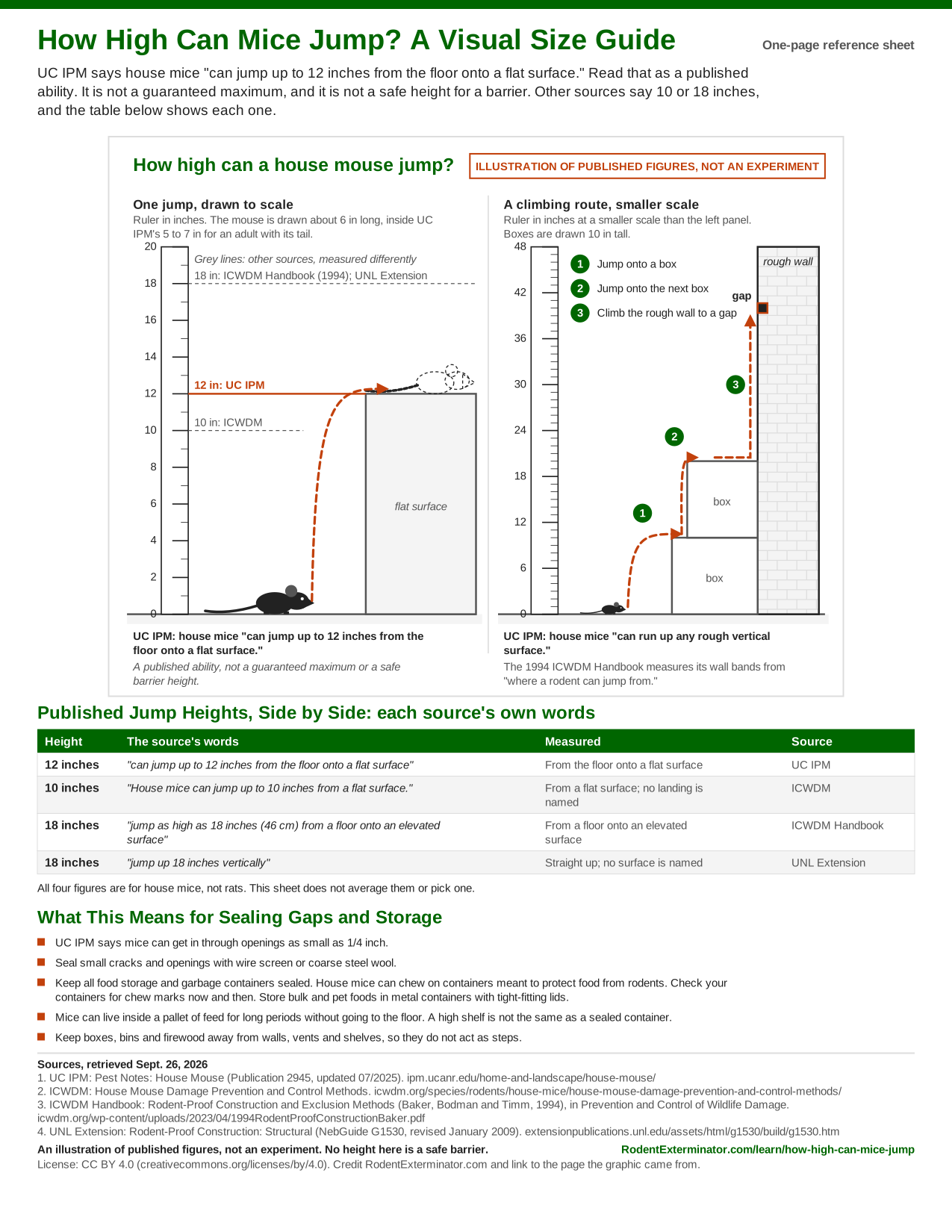
The reference sheet puts the ruler graphic, the table of published heights and the storage tips on one Letter-size page. The files are free, with no sign-up.
Related Guides
If mice are already inside, the mouse control page walks through finding the gaps, removing the mice and sealing up.
For more on size, signs and habits, see the house mouse profile.
Sources
- UC Statewide IPM Program (UC IPM), University of California Agriculture and Natural Resources. Pest Notes: House Mouse (Publication 2945, updated 07/2025). ipm.ucanr.edu/home-and-landscape/house-mouse/. Retrieved Sep 26, 2026.
- Internet Center for Wildlife Damage Management (ICWDM). House Mouse Damage Prevention and Control Methods. icwdm.org/species/rodents/house-mice/house-mouse-damage-prevention-and-control-methods/. Retrieved Sep 26, 2026.
- Internet Center for Wildlife Damage Management (ICWDM), handbook chapter hosted by ICWDM. Rodent-Proof Construction and Exclusion Methods (Baker, Bodman and Timm, 1994), in Prevention and Control of Wildlife Damage. icwdm.org/wp-content/uploads/2023/04/1994RodentProofConstructionBaker.pdf. Retrieved Sep 26, 2026.
- University of Nebraska-Lincoln Extension. Rodent-Proof Construction: Structural (NebGuide G1530, revised January 2009). extensionpublications.unl.edu/assets/html/g1530/build/g1530.htm. Retrieved Sep 26, 2026.