Visual guide
Can Mice Climb Walls? A Visual Guide
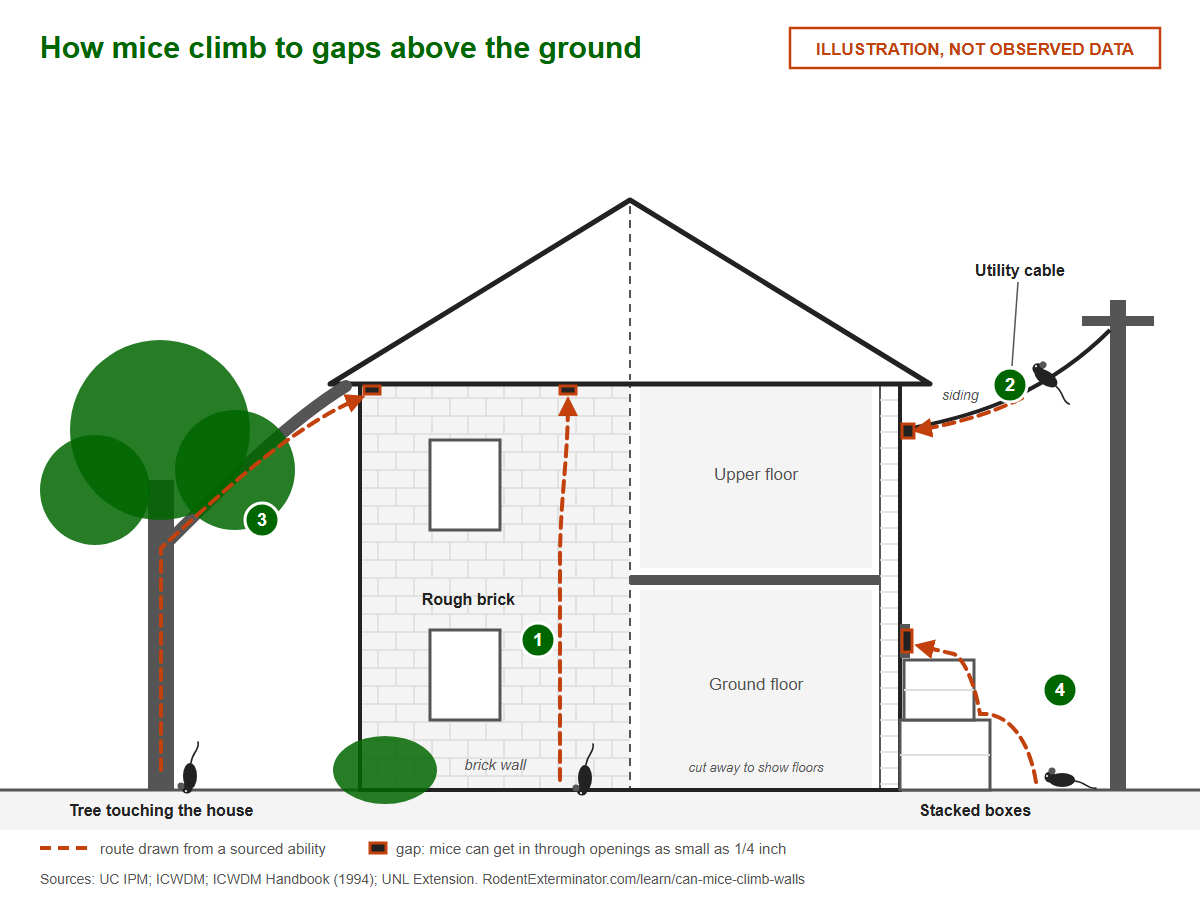
Yes, UC IPM calls house mice excellent climbers that can run up any rough vertical surface. Rats and mice can also run along or climb wires, pipes, vines, shrubs and trees to get into a building. So check for gaps up high, not only near the ground.
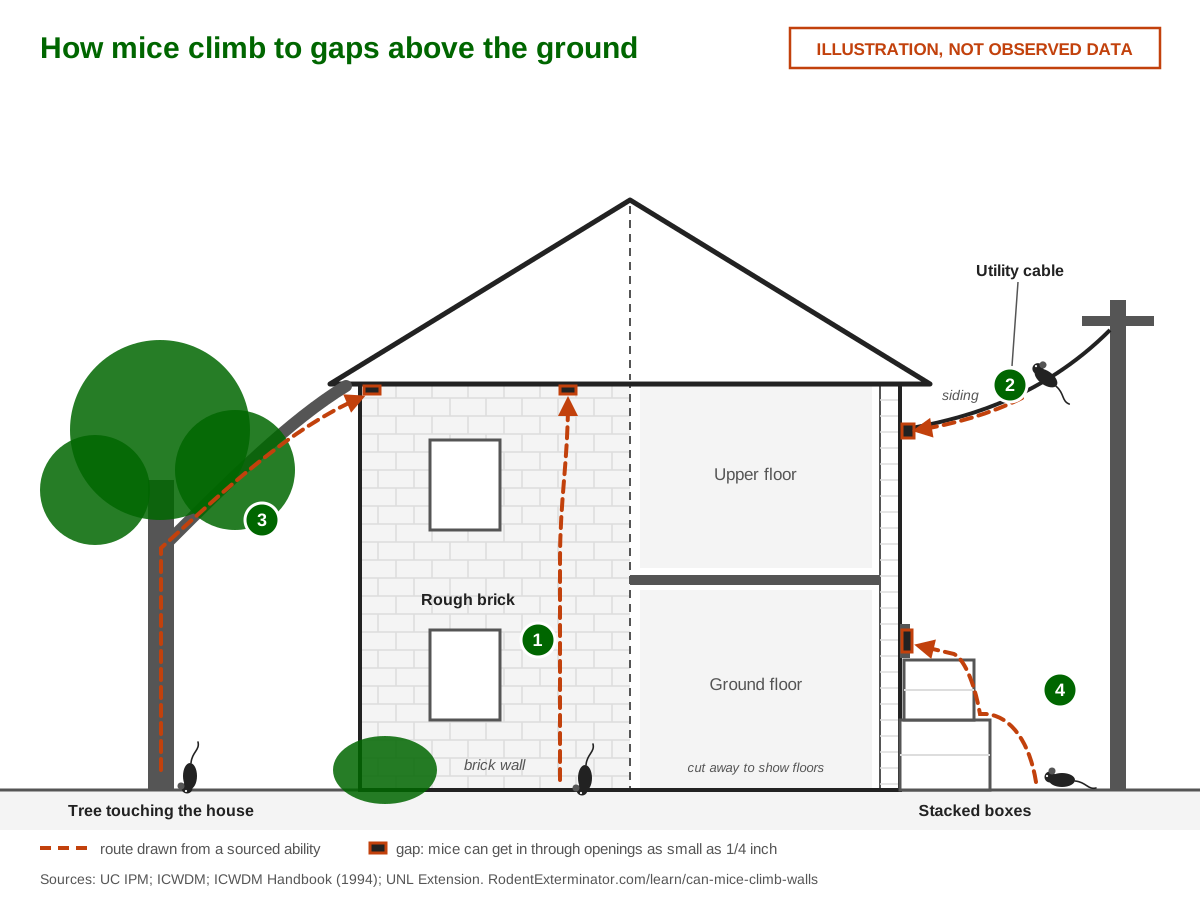
Four Climbing Routes on a House
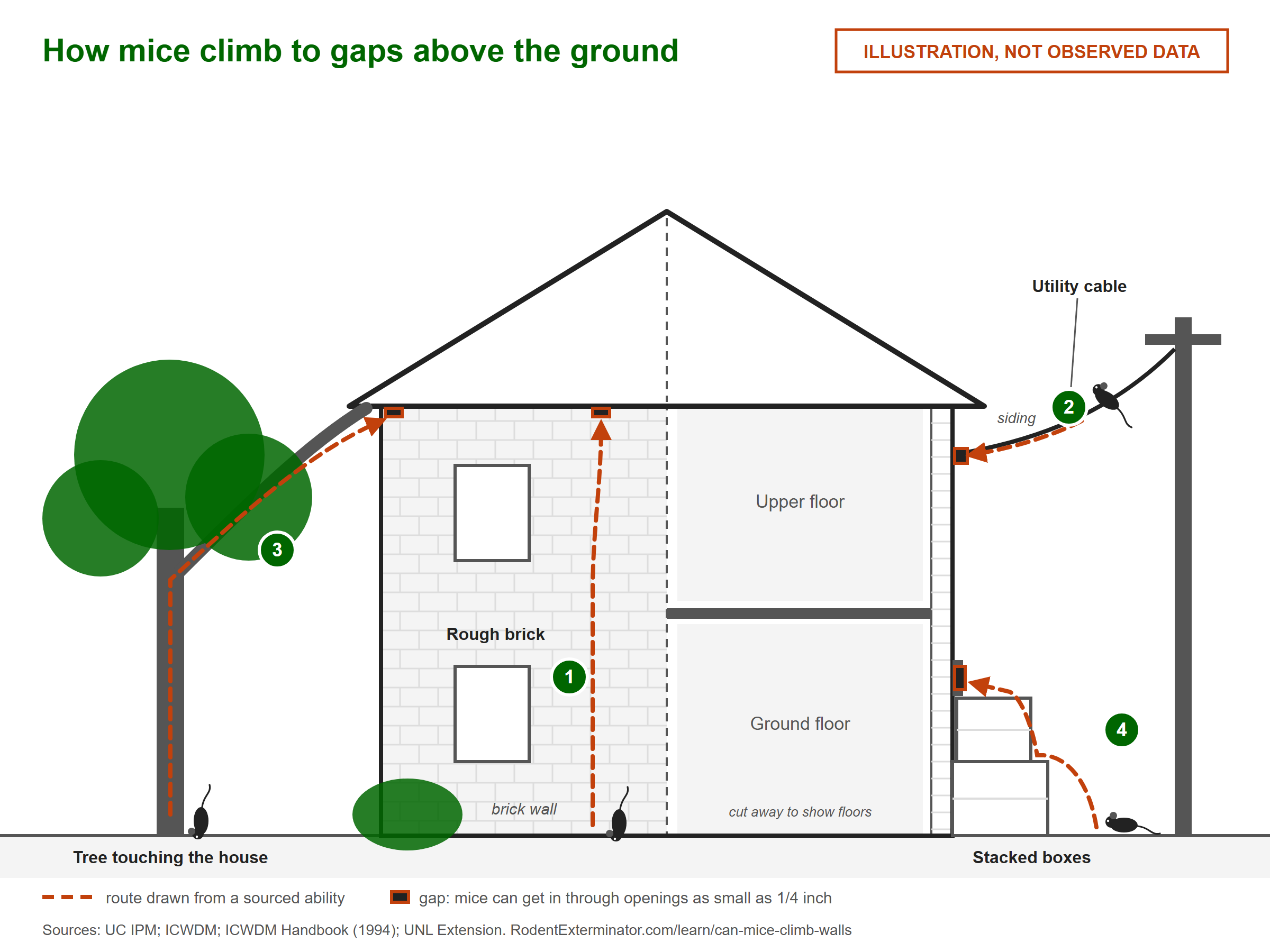
The numbers below match the numbers on the drawing.
Route 1: Up rough siding or brick
Rats and mice can climb almost any rough vertical surface, such as wood, brick and concrete.
Route 2: Along wires and cables
House mice will run sideways along wire cables or ropes. Rats and mice also run along or climb electrical wires, cables, pipes and poles to get into a building.
Route 3: Up plants and trees that touch the house
Rats and mice climb or run along vines, shrubs and trees to get inside. UC IPM advises thinning or removing plants next to or climbing up a building, because house mice are excellent climbers.
Route 4: From stacked objects by a wall
UC IPM says house mice can jump from the floor onto a flat surface up to 12 inches high. Another source says 10 inches, so treat any number as a guide, not a limit. Two others say 18 inches, and our jumping guide shows each figure side by side. A 1994 building handbook places vents at least 40 inches above the ground, fences or shrubs. Boxes, bins or firewood piled by a wall can give a mouse the same kind of starting point.
At the top of each route, a mouse only needs a small gap. UC IPM says a gap as small as 1/4 inch can let a mouse in.
Climbing-Surface Chart
This chart shows what mice can climb, surface by surface. Some rows cover rats and mice together, not house mice alone. The last column says which.
| Surface or route | What the source says | Who and when |
|---|---|---|
| Any rough vertical surface | can run up any rough vertical surface1 | House mice |
| Wood and concrete | can walk up surfaces such as wood or concrete2 | House mice, unless the surface has a slick finish |
| Brick and weathered sheet metal | climb almost any rough vertical surface, such as wood, brick, concrete, weathered sheet metal3,4 | Rats and mice |
| Many plastic products | and many plastic products3 | Rats and mice. Same list as the brick row. |
| Wires, cables and ropes | run horizontally along wire cables or ropes1,3 | House mice. Rats and mice also use electrical wires. |
| Pipes and conduit | crawl horizontally along or through pipes, augers, conveyors, conduit3 | Rats and mice |
| Fences and poles | run along or climb electrical wires, pipes, fences, poles3 | Rats and mice, to get into a building |
| Vines, shrubs and trees | vines, shrubs, and trees1,3 | Rats and mice, climbing or running along them to get into a building |
| Screen wire | travel considerable distances crawling upside-down along screen wire3 | House mice |
| Gap beside an overhead door track | can easily climb up the space between the door and the inner wall or track3 | Rats and mice, at roll-up or overhead doors |
| Surface with a slick finish | unless the surface has a slick finish2 | House mice. The exception to the wood and concrete row. |
| Slick door surface | if the door surface is too slick for rodents to climb3 | Rodents, at doors |
| Sheet metal band on a wall (a recommended guard) | A sheet metal band attached to a wall will prevent rodents from climbing.3,4 | Rodents. Advice, not a guarantee. A band must be wide enough and placed so rodents can't reach the edges by climbing or jumping. The 1994 handbook says 14 to 18 inches wide, 30 inches above where a rodent can jump from, with examples such as barns, corn cribs, dock areas and pumping plants. UNL says 12- to 18-inch-wide aluminum bands, at least 36 inches above the ground or at floor level, and its drawing puts them at the inside corners of rooms. |
No surface in this chart is a sure barrier. The metal band is a recommendation, not a guarantee, and it must be wide enough and placed so rodents can't reach its edges.
Why Texture, Edges and Footholds Matter
Texture
Mice run up rough surfaces, and they walk up wood or concrete unless it has a slick finish. If a wall is rough, a 1994 building handbook suggests a smooth surface around a vent. Where rat or mouse problems are heavy, it suggests building materials with a hard, smooth surface on the lower levels.
Edges and corners
UNL recommends sheet metal bands to keep rodents from climbing walls, especially in corners. For roof vents, the 1994 handbook advises smooth sheet metal with no rough edge ribs or other surfaces that rodents can climb. Rats and mice can also climb the space beside an overhead door track. Edges matter for gnawing too. Rodents often gnaw into walls at corners or where joints in building materials give them an edge.
Nearby footholds
The 1994 handbook sets its wall bands 30 inches above where a rodent can jump from. Treat anything a mouse can stand on next to a wall as a possible starting point. Penn State Extension advises pruning trees, shrubs and groundcover so they are not touching the building. Moving stored items away from the wall takes away a place to climb or jump from.
Printable Inspection Checklist
Take this list on a walk around the house. Tick each box as you go.
- Look for trees, shrubs, vines or groundcover touching the walls or roof.
- Follow each wire, cable and pipe to where it enters the house. Seal around these openings with metal or concrete.
- Look for any gap of 1/4 inch or more, both low and high on the house.
- Check rough siding, brick and corners below upper-floor vents, eaves and the roofline.
- Check the sides and top of each garage or roll-up door track for gaps.
- Note any boxes, bins or firewood stacked against a wall near a gap or vent.
- Check that vent covers are whole. Cover openings with 1/4-inch wire mesh.
- Look near each opening for rub marks, droppings, tracks or gnawing.
- Mark any high or hard-to-reach gap for a professional instead of climbing a tall ladder.
From Can Mice Climb Walls? A Visual Guide, rodentexterminator.com/learn/can-mice-climb-walls
Download the Reference Sheet
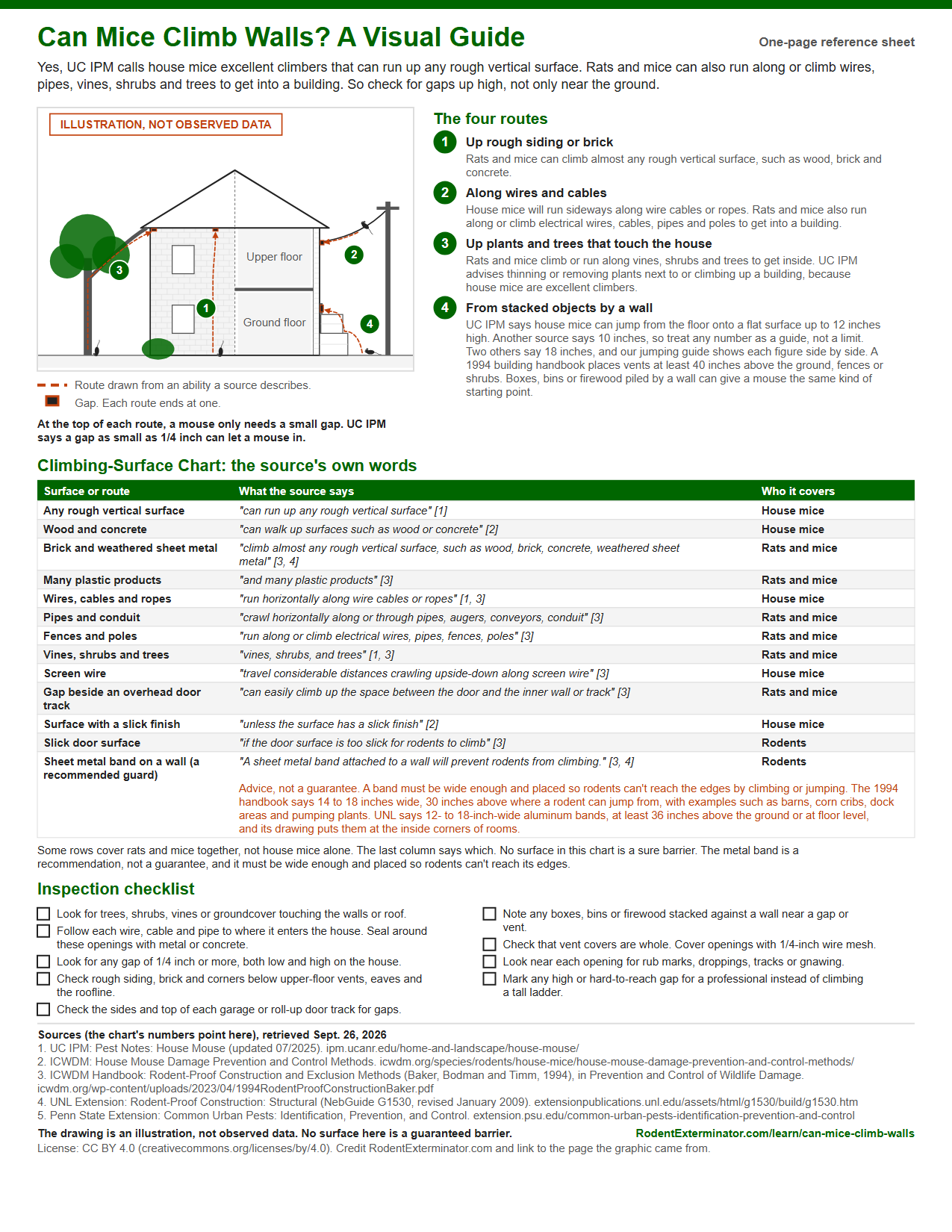
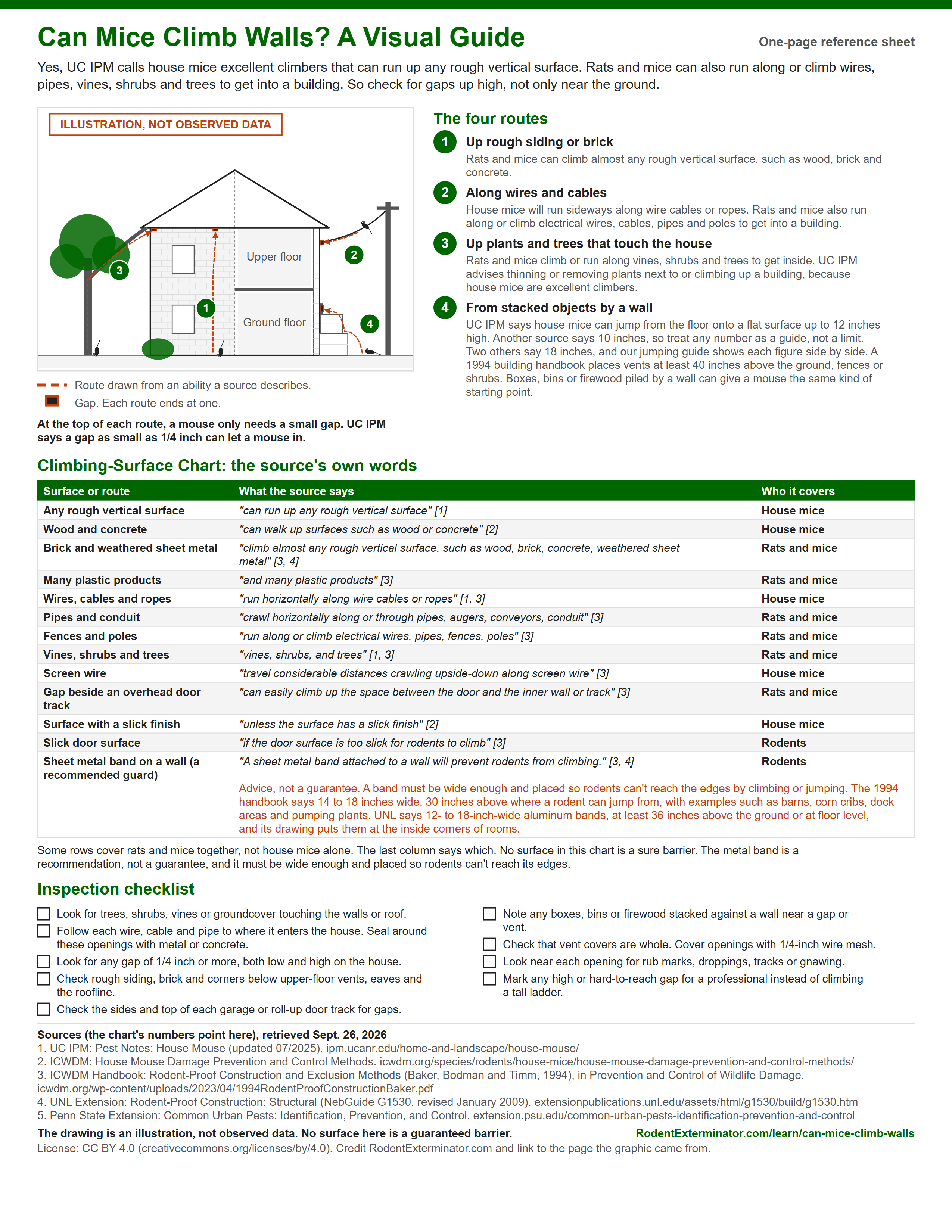
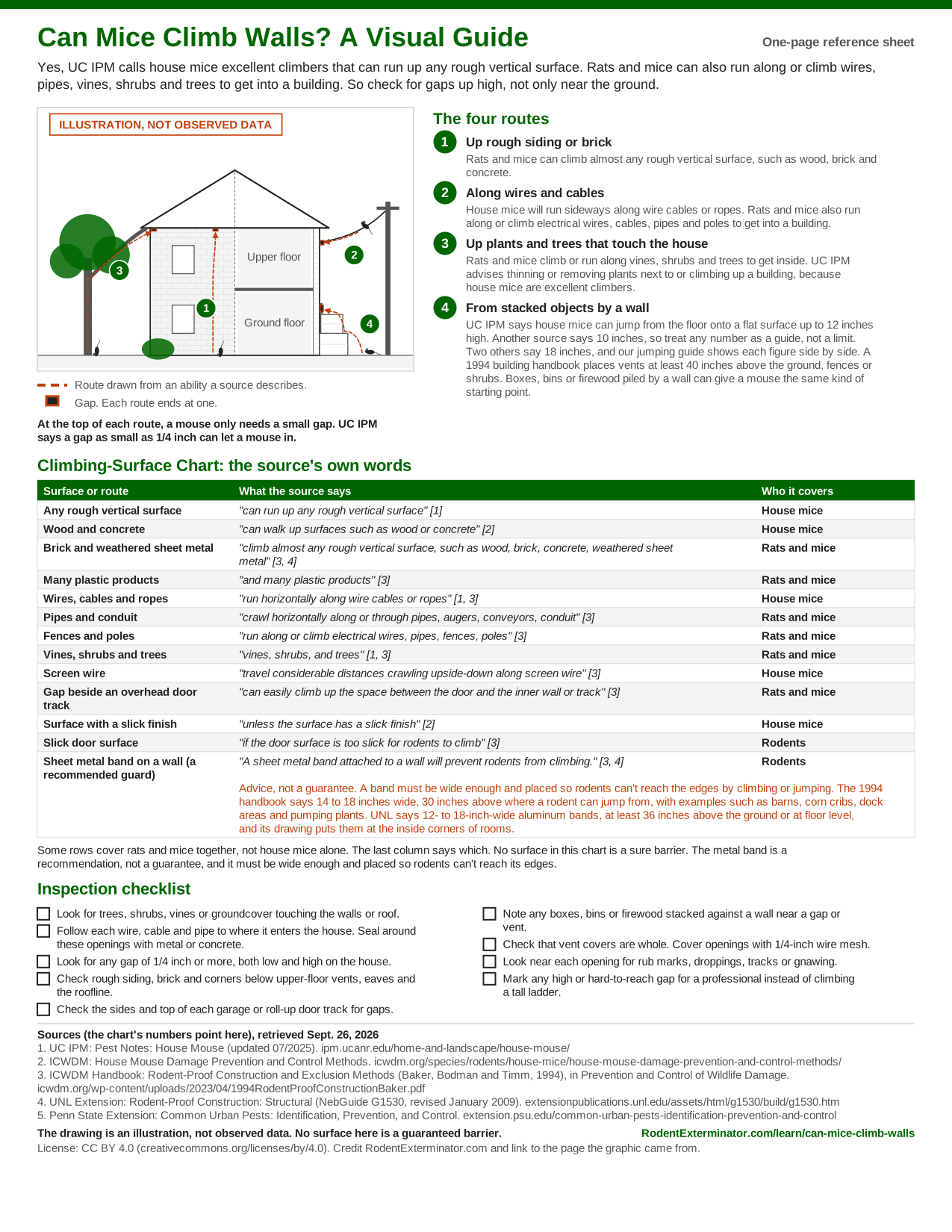
The reference sheet puts the drawing, the chart and the checklist on one Letter-size page. The files are free, and there is no sign-up.
Where to Go Next
The mouse control page covers finding the entry points, clearing the mice and sealing the house.
The rodent exclusion page explains how gaps get sealed with steel mesh, hardware cloth and sealants.
Our guide to rodent entry points in a house walks through rooflines, vents, utility lines and garage doors.
The house mouse profile covers size, droppings and nesting habits.
To see a single jump on a ruler next to each published height, read How High Can Mice Jump?
Sources
- UC Statewide IPM Program (UC IPM), University of California Agriculture and Natural Resources. Pest Notes: House Mouse (updated 07/2025). ipm.ucanr.edu/home-and-landscape/house-mouse/. Retrieved Sep 26, 2026.
- Internet Center for Wildlife Damage Management (ICWDM). House Mouse Damage Prevention and Control Methods. icwdm.org/species/rodents/house-mice/house-mouse-damage-prevention-and-control-methods/. Retrieved Sep 26, 2026.
- Internet Center for Wildlife Damage Management (ICWDM), handbook chapter hosted by ICWDM. Rodent-Proof Construction and Exclusion Methods (Baker, Bodman and Timm, 1994), in Prevention and Control of Wildlife Damage. icwdm.org/wp-content/uploads/2023/04/1994RodentProofConstructionBaker.pdf. Retrieved Sep 26, 2026.
- University of Nebraska-Lincoln Extension. Rodent-Proof Construction: Structural (NebGuide G1530, revised January 2009). extensionpublications.unl.edu/assets/html/g1530/build/g1530.htm. Retrieved Sep 26, 2026.
- Penn State Extension. Common Urban Pests: Identification, Prevention, and Control. extension.psu.edu/common-urban-pests-identification-prevention-and-control. Retrieved Sep 26, 2026.